SodaTide Official Website › Blog › A Blend With No Strain Names
A Probiotic Blend With No Strain Names Cannot Borrow Anybody’s Trial
Probiotic research is written strain by strain, and a strain designation is not a technicality: it is the unit of evidence. A label that says “probiotic blend” and stops has given a reader a category rather than an organism, and no published result can be attached to it. This is the post that costs the product something.
What a probiotic is defined to be
The ISAPP consensus statement defines a probiotic as a live micro-organism that, when administered in an adequate amount, confers a health benefit on the host. That sentence has been the working definition in the field since 2014 and it contains two conditions that are easy to read past.
The first is that the organism is live. The second is that the amount is adequate, and adequacy is defined per organism rather than in general. There is no universal number of bacteria that constitutes a dose, in the way there is a milligram figure for a vitamin.
So a probiotic claim has two components and a label that supplies neither has not made a claim that can be assessed. It has named a category.
- Which organism, named to strain: genus, species and strain designation.
- How much, as a colony-forming-unit count.
- Ideally, when that count applies: at manufacture, or through the shelf life.
- And for a live product, how it is stored.
Why the strain is the unit
It is tempting to treat strain designations as a marketing detail, in the way a batch number is. They are not. Two strains of the same species can differ in which compounds they produce, which receptors they interact with and whether they survive the journey at all, and the clinical literature reflects that: results are reported for strains and are not routinely generalised even to close relatives.
This has a direct consequence for a reader of any supplement label. If the label names a strain, the evidence for that strain can be looked up. If it names a species, the search is already much less precise. If it names a blend, there is nothing to search for.
SodaTide's artwork names a Probiotic Blend and stops. That is the honest state of the label, and it means no result in the paragraphs below can be attached to this capsule.

What a strain designation looks like
A reader who has never had reason to look at one may not know what is being asked for, so here it is taken apart. “Lactobacillus gasseri SBT2055” has three parts and each carries different information.
“Lactobacillus” is the genus, which is a broad grouping. “gasseri” is the species. “SBT2055” is the strain designation, a code assigned by whoever isolated and deposited it, and it is the only part that identifies the specific organism a trial studied.
Two strains within one species can behave quite differently, which is why the third part is the one the evidence is indexed by. A label printing only the first two has narrowed the field but has not identified anything a reader can look up.
| What a label prints | How precise it is | Can you look up the evidence? |
|---|---|---|
| Probiotic blend | A category | No. There is nothing to search for. |
| Lactobacillus | A genus, hundreds of species | Not usefully. |
| Lactobacillus gasseri | A species | Partially, but results are strain-specific. |
| Lactobacillus gasseri SBT2055 | A strain | Yes. This is the unit trials use. |
Four levels of precision. Only the last one connects a label to a literature.
Two trials, two strains, two numbers
What the field produces when a strain IS named is worth seeing, both because it is interesting and because it shows exactly what a blend without names is missing.
| Strain | Dose used | Length | What was reported |
|---|---|---|---|
| Akkermansia muciniphila | 10^10 cells a day, live or pasteurised | 3 months | Safe and well tolerated. The pasteurised form improved insulin sensitivity by about 29 per cent and reduced insulinaemia and total cholesterol against placebo |
| Lactobacillus gasseri SBT2055 | 200 g a day of fermented milk carrying it | 12 weeks | Abdominal visceral and subcutaneous fat areas fell by about 4.6 and 3.3 per cent from baseline, with small reductions in body weight and waist |
Both figures are as the papers report them. Neither trial studied this product, and neither result transfers to a blend whose members are unnamed.
The Akkermansia study is the most cited single result in this area and it is a proof-of-concept study in forty enrolled volunteers, thirty-two of whom completed it. The L. gasseri trial is larger and older and used a food rather than a capsule. They are here to show the form a usable probiotic result takes: one organism, one number, one period.
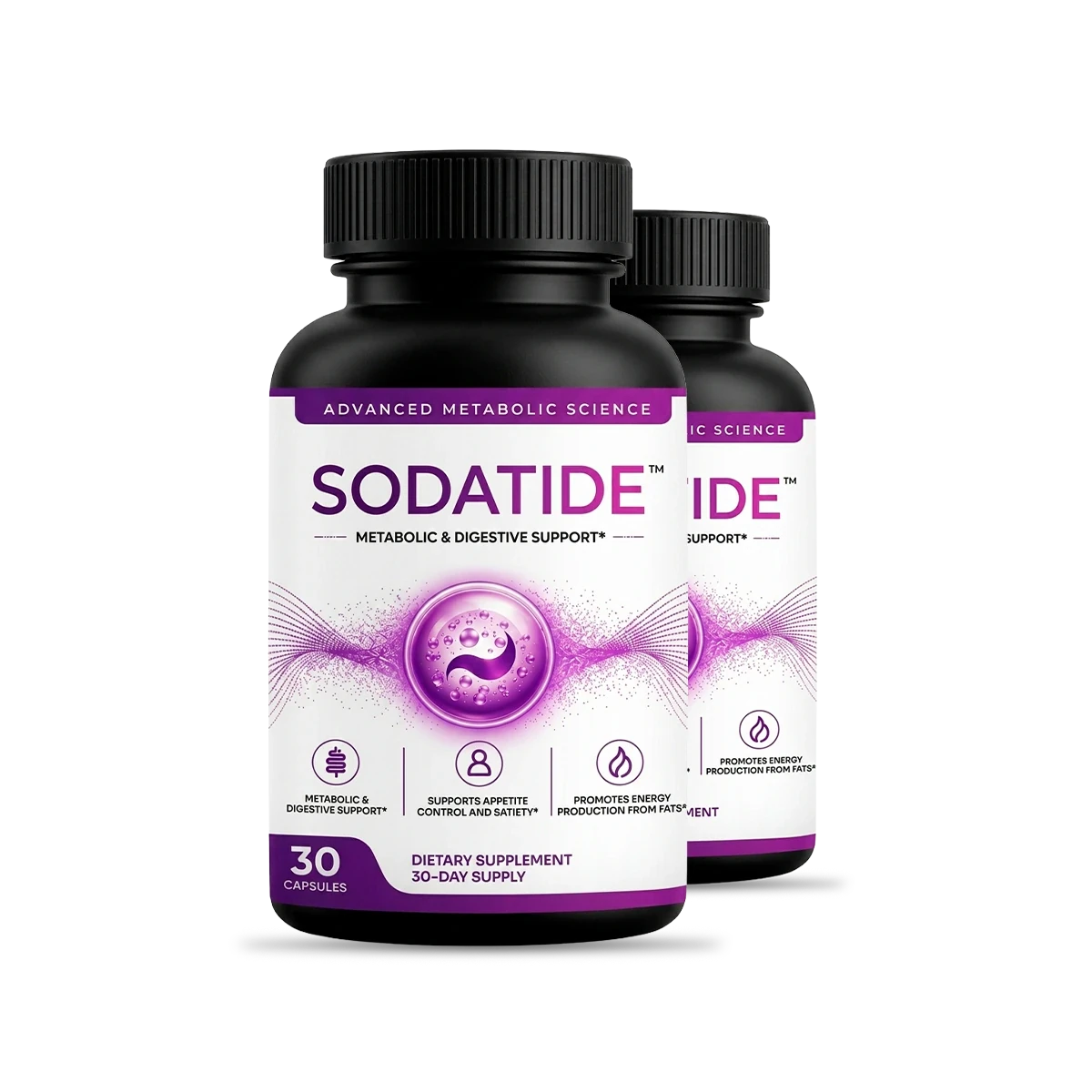
SodaTide pairs its blend with two prebiotic fibres
The fibres are the better-documented half of this label. The ingredients page prints the amount every published trial of each one used, beside the name.
Two bottles $158 · six bottles $294 · 60-day money-back guarantee
Order SodaTide On The Official WebsiteOne capsule a day · 30 per bottle · lot SOD-26/SO-5430
What pooling strain-specific results produces
A systematic review and meta-analysis looked at probiotics and body adiposity in people with overweight and obesity, across randomised trials. The general finding across this kind of pooling is a small average effect, which is what you would expect when results that are specific to particular organisms are averaged together.
That is not a criticism of the analysis. It is a structural feature of the question: pooling strain-specific effects estimates the average effect of a heterogeneous intervention, and the average of several different things is not a prediction about any one of them.
For a buyer the practical reading is that “probiotics work” and “probiotics do nothing” are both too coarse to be useful, and that the only version of the question with an answer names an organism.
Why a count is also what makes a label checkable
An audit of commercial probiotic products compared what labels claimed against what the products actually contained. The two agreed less often than a buyer would assume, and that finding is the practical argument for printing strains and counts rather than a philosophical one.
A printed count is a testable statement. A bottle claiming ten billion organisms of a named strain can be sent to a laboratory and checked. A bottle claiming a probiotic blend cannot be checked at all, because there is no claim to compare a result against.
There is a storage dimension to the same point. Stability work on live cultures shows survival depends on temperature across the whole period between manufacture and use. A count printed without a statement about when it applies is a weaker claim than a count guaranteed through the shelf life.
- A strain designation: the organism, precisely enough to look up.
- A colony-forming-unit count: the amount.
- When the count applies: at manufacture, or to the best-before date.
- A storage instruction, which SodaTide's label does carry and many do not.
SodaTide answers the fourth of those four. The refrigeration instruction on this bottle is explicit and it is more than several competitors print. The other three are open, and on a live-culture product they are the three that decide whether a claim means anything.
Three lines that would fix this label
It is easy to catalogue what is absent and harder to say what would actually help. Three lines of additional label text would move this pack from ordinary to unusually good, and none of them requires reformulating anything.
- A strain list: genus, species and strain designation for each organism in the blend. This is what makes any published result findable.
- A colony-forming-unit count, with a statement of whether it applies at manufacture or through the best-before date. The second version is a stronger promise and costs nothing extra to make if it is true.
- An other-ingredients line naming the capsule shell, which would also settle whether the vegetarian mark on this pack means what a vegetarian would take it to mean.
All three are printing decisions. A manufacturer who knows what is in the blend already has the information, and a manufacturer who does not know has a larger problem than a label.
If the artwork ever gains them, this page changes and the review date at the foot of it moves. Anyone holding a bottle whose label already carries more than this describes should write to the editorial address, because the bottle is the authority and this desk would rather be corrected than current.
What this desk will and will not say
This website sells the product and this post is the least flattering thing on it, which is deliberate. A retail desk that only publishes what helps a sale is not worth reading, and the standing rules here are simple enough to state.
It will not name a strain the label does not name. The seller's own information page mentions Akkermansia muciniphila as an example of the kind of organism involved; that statement does not travel onto this site, because a reader would reasonably take it as a description of what is in the capsule.
It will not attach a trial result to a blend. The two trials above are cited for what they tested, at the amounts they used, and never as evidence about this product.
And it will not describe the gap as fatal. Two of the three named ingredients on this label are prebiotic fibres with a large and readable literature, and those are the better-documented half of the formula. The honest position is that the fibre side can be reasoned about and the culture side cannot, and a buyer deserves to know which is which before ordering.
The ingredient-by-ingredient reading is on the ingredients page, the seal analysis is on testing and quality, and the complete list of claims this desk refused to carry is on the benefits page.
SodaTide is a dietary supplement, not a drug. Nothing on this page treats, cures or prevents anything, and nothing here is medical advice. A persistent change in bowel habit, unexplained weight change, blood, pain or fever are reasons to be assessed by a clinician rather than reasons to start a capsule.
References
- Hill C, Guarner F, Reid G, et al, 2014: “Expert consensus document: The International Scientific Association for Probiotics and Prebiotics consensus statement on the scope and appropriate use of the term probiotic” in Nat Rev Gastroenterol Hepatol 11(8):506-14, PubMed ID 24912386 — PubMed entry
- Depommier C, Everard A, Druart C, et al, 2019: “Supplementation with Akkermansia muciniphila in overweight and obese human volunteers: a proof-of-concept exploratory study” in Nat Med 25(7):1096-1103, PubMed ID 31263284 (Dose 10^10 live or pasteurised cells a day for three months) — PubMed entry
- Kadooka Y, Sato M, Imaizumi K, et al, 2010: “Regulation of abdominal adiposity by probiotics (Lactobacillus gasseri SBT2055) in adults with obese tendencies in a randomized controlled trial” in Eur J Clin Nutr 64(6):636-43, PubMed ID 20216555 (Dose 200 g a day of fermented milk carrying the strain, for 12 weeks) — PubMed entry
- Weese JS, Martin H, 2011: “Assessment of commercial probiotic bacterial contents and label accuracy” in Can Vet J 52(1):43-6, PubMed ID 21461205 — PubMed entry
- Pontes KSDS, Guedes MR, Cunha MRD, et al, 2021: “Effects of probiotics on body adiposity and cardiovascular risk markers in individuals with overweight and obesity: A systematic review and meta-analysis of randomized controlled trials” in Clin Nutr 40(8):4915-4931, PubMed ID 34358838 — PubMed entry
- Chaluvadi S, Hotchkiss AT Jr, Call JE, et al, 2012: “Protection of probiotic bacteria in a synbiotic matrix following aerobic storage at 4 degrees C” in Benef Microbes 3(3):175-87, PubMed ID 22968408 — PubMed entry