SodaTide Official Website › Metabolism Supplement Guide
Metabolism Supplement GuideThe Metabolism Supplement Guide: What The Category Contains And Where The Evidence Actually Is
“Metabolism supplement” covers at least five different ideas.
Stimulants that raise energy expenditure, bulking fibres that fill a stomach, fermentable fibres that feed gut bacteria, live cultures that add organisms, and vitamin and mineral products sold on a metabolic story. They work by unrelated mechanisms and their evidence differs enormously.
A fifteen-minute read on what is on the shelf, what each part of it does, and which claims survive contact with the literature.
Five things the word “metabolism” is doing on a shelf
| Category | Typical ingredients | Proposed mechanism | Evidence position |
|---|---|---|---|
| Thermogenics | Caffeine, green tea catechins, capsicum, synephrine | Raise energy expenditure and fat oxidation acutely | Real acute effects, small and short-lived; the stimulant side carries the cardiovascular cautions. |
| Bulking fibres | Glucomannan, psyllium | Take up space and slow gastric emptying | Modest and reasonably consistent for satiety; dosed in grams before meals. |
| Fermentable prebiotic fibres | Inulin, oligofructose, resistant starch | Feed gut bacteria; short-chain fatty acids affect appetite hormones | The most interesting body of work in the category, all of it at gram doses. |
| Live cultures | Named probiotic strains | Compete, secrete, and affect the gut barrier | Strain-specific. A named strain with a count means something; a blend with neither does not. |
| Metabolic vitamins and minerals | B vitamins, chromium, iodine | Cofactors in energy metabolism | Meaningful only where somebody is deficient, which most buyers are not. |
Five categories, five mechanisms, and almost nothing transferable between them.
The practical consequence is that “does a metabolism supplement work?” is not a question with an answer. Each row above has its own literature and its own dose range, and a product combining two of them inherits both sets of caveats rather than averaging them.
Where the evidence is strongest, and what it actually shows
The fermentable fibre row has the clearest recent work, and it is worth seeing what “clear” means here. A 12-week randomised trial gave 21 grams a day of oligofructose to forty-eight overweight adults and recorded a weight reduction of about one kilogram against a control group that gained about half of one, with lower ghrelin and higher peptide YY alongside it.
A crossover in healthy adults at 16 grams a day measured total daily energy intake about 5 per cent lower. A 16-week trial in children at 8 grams a day measured body fat directly and found reductions against placebo. The 2024 chicory inulin meta-analysis pools the weight outcomes across this literature.
On the short-chain fatty acid side, a 24-week trial delivered 10 grams a day of an inulin-propionate ester and measured lower weight gain and less intra-abdominal fat than the inulin-only control. That is the cleanest evidence anywhere that the fatty acids rather than the fibre itself are doing the work.
Every amount in those paragraphs is grams a day, sustained over weeks. Any capsule-format product in this category is working at a fraction of it, and the honest question to ask of a capsule is not whether the ingredient has evidence but how much of the ingredient is in the capsule.
What a short-chain fatty acid is, and why it keeps coming up
Fermentation of fibre in the colon produces acetate, propionate and butyrate. The standard review of colonic function sets out where each goes: butyrate is consumed by the cells lining the colon, while acetate and propionate reach the liver and the circulation.
They matter because they are the only plausible route by which something that is never absorbed as itself can affect appetite. A fibre that passes through unchanged could not influence a hormone; a fibre that is converted into circulating fatty acids can.
A follow-up study looked at hepatic steatosis in adults with fatty liver disease, and a 2025 trial measured the simpler and more immediate outcome, which is bowel habit.
The corollary is worth stating because it is often skipped. If the mechanism runs through fermentation, then the gas that comes with fermentation is not a side effect in the usual sense. Tolerance work at 5 and 7.5 grams a day records bloating, flatulence and rumbling rising slightly against control, and that is the mechanism announcing itself.
Live cultures: why a strain name is not a detail
The ISAPP consensus statement defines a probiotic as a live micro-organism that confers a health benefit when administered in an adequate amount. Both halves of that definition are specific, and the specificity is the whole subject.
The Akkermansia muciniphila study tested one organism at 10^10 cells a day for three months in overweight, insulin-resistant volunteers and reported improved insulin sensitivity for the pasteurised form. A 12-week trial of L. gasseri SBT2055 used 200 grams a day of a fermented milk carrying that strain and measured abdominal fat area by scan. Neither result is a statement about probiotics in general.
The pooled picture across trials in overweight and obese adults is a small average effect on body fat, which is what pooling strain-specific results usually produces. And an audit of commercial products found labels and bottle contents agreeing less often than a buyer would assume, which is the practical reason a strain list and a count matter: they are what makes a claim checkable at all.
- Which organisms, named to strain rather than to species?
- How many, as a colony-forming-unit count?
- Counted at manufacture, or guaranteed to the end of the shelf life?
- How is it stored, and does the label say so?
What this category cannot do, stated plainly
No supplement in any of the five rows above treats a disease, and nothing here is a substitute for a diagnosis. A persistent change in bowel habit, unexplained weight loss, blood, pain or fever are reasons to be assessed rather than reasons to try a capsule.
Nothing here produces dramatic weight change either. The largest effect in the best-conducted fibre trial in this space was about a kilogram over twelve weeks at 21 grams a day, and the wider fibre literature associates benefit with intakes of 25 to 29 grams a day from food, sustained over years.
And individual variation is larger here than in most supplement categories. A study designed to look at it found the microbiome response to resistant starch differed substantially between people, which means two readers can run the same experiment and get different answers without either of them doing anything wrong.
How this SodaTide page was sourced, and by whom
Seventeen sources, every one confirmed against its NCBI record during this build, with the amount each trial used included in the line.
- Parnell JA, Reimer RA. Weight loss during oligofructose supplementation is associated with decreased ghrelin and increased peptide YY in overweight and obese adults. Am J Clin Nutr. 2009;89(6):1751-9. PMID 19386741. Dose: 21 g a day for 12 weeks. https://pubmed.ncbi.nlm.nih.gov/19386741/
- Cani PD, Joly E, Horsmans Y, Delzenne NM. Oligofructose promotes satiety in healthy human: a pilot study. Eur J Clin Nutr. 2006;60(5):567-72. PMID 16340949. Dose: 8 g twice a day, 16 g a day in total. https://pubmed.ncbi.nlm.nih.gov/16340949/
- Nicolucci AC, Hume MP, Martinez I, et al. Prebiotics Reduce Body Fat and Alter Intestinal Microbiota in Children Who Are Overweight or With Obesity. Gastroenterology. 2017;153(3):711-722. PMID 28596023. Dose: 8 g a day of oligofructose-enriched inulin for 16 weeks. https://pubmed.ncbi.nlm.nih.gov/28596023/
- Reimer RA, Soto-Vaca A, Nicolucci AC, et al. The effects of chicory inulin-type fructans supplementation on weight management outcomes: systematic review, meta-analysis, and meta-regression of randomized controlled trials. Am J Clin Nutr. 2024;120(4):972-983. PMID 39313030. https://pubmed.ncbi.nlm.nih.gov/39313030/
- Chambers ES, Viardot A, Psichas A, et al. Effects of targeted delivery of propionate to the human colon on appetite regulation, body weight maintenance and adiposity in overweight adults. Gut. 2015;64(11):1744-54. PMID 25500202. Dose: 10 g a day of inulin-propionate ester for 24 weeks. https://pubmed.ncbi.nlm.nih.gov/25500202/
- Topping DL, Clifton PM. Short-chain fatty acids and human colonic function: roles of resistant starch and nonstarch polysaccharides. Physiol Rev. 2001;81(3):1031-64. PMID 11427691. https://pubmed.ncbi.nlm.nih.gov/11427691/
- Chambers ES, Byrne CS, Rugyendo A, et al. The effects of dietary supplementation with inulin and inulin-propionate ester on hepatic steatosis in adults with non-alcoholic fatty liver disease. Diabetes Obes Metab. 2019;21(2):372-376. PMID 30098126. https://pubmed.ncbi.nlm.nih.gov/30098126/
- Puhlmann ML, Wegh CAM, van der Zalm SCC, et al. Inulin-induced improvements on bowel habit and gut microbiota in adults with functional constipation: findings of a randomized, double-blind, placebo-controlled study. BMC Gastroenterol. 2025;25(1):806. PMID 41233756. https://pubmed.ncbi.nlm.nih.gov/41233756/
- Holscher HD, Doligale JL, Bauer LL, et al. Gastrointestinal tolerance and utilization of agave inulin by healthy adults. Food Funct. 2014;5(6):1142-9. PMID 24664349. Doses: 5.0 and 7.5 g a day over three 21-day periods. https://pubmed.ncbi.nlm.nih.gov/24664349/
- Hill C, Guarner F, Reid G, et al. Expert consensus document. The International Scientific Association for Probiotics and Prebiotics consensus statement on the scope and appropriate use of the term probiotic. Nat Rev Gastroenterol Hepatol. 2014;11(8):506-14. PMID 24912386. https://pubmed.ncbi.nlm.nih.gov/24912386/
- Depommier C, Everard A, Druart C, et al. Supplementation with Akkermansia muciniphila in overweight and obese human volunteers: a proof-of-concept exploratory study. Nat Med. 2019;25(7):1096-1103. PMID 31263284. Dose: 10^10 live or pasteurised cells a day for three months. https://pubmed.ncbi.nlm.nih.gov/31263284/
- Kadooka Y, Sato M, Imaizumi K, et al. Regulation of abdominal adiposity by probiotics (Lactobacillus gasseri SBT2055) in adults with obese tendencies in a randomized controlled trial. Eur J Clin Nutr. 2010;64(6):636-43. PMID 20216555. Dose: 200 g a day of fermented milk carrying the strain, for 12 weeks. https://pubmed.ncbi.nlm.nih.gov/20216555/
- Pontes KSDS, Guedes MR, Cunha MRD, et al. Effects of probiotics on body adiposity and cardiovascular risk markers in individuals with overweight and obesity: A systematic review and meta-analysis of randomized controlled trials. Clin Nutr. 2021;40(8):4915-4931. PMID 34358838. https://pubmed.ncbi.nlm.nih.gov/34358838/
- Weese JS, Martin H. Assessment of commercial probiotic bacterial contents and label accuracy. Can Vet J. 2011;52(1):43-6. PMID 21461205. https://pubmed.ncbi.nlm.nih.gov/21461205/
- Reynolds A, Mann J, Cummings J, et al. Carbohydrate quality and human health: a series of systematic reviews and meta-analyses. Lancet. 2019;393(10170):434-445. PMID 30638909. https://pubmed.ncbi.nlm.nih.gov/30638909/
- Venkataraman A, Sieber JR, Schmidt AW, et al. Variable responses of human microbiomes to dietary supplementation with resistant starch. Microbiome. 2016;4(1):33. PMID 27357127. https://pubmed.ncbi.nlm.nih.gov/27357127/
- Gibson GR, Hutkins R, Sanders ME, et al. Expert consensus document: The International Scientific Association for Probiotics and Prebiotics (ISAPP) consensus statement on the definition and scope of prebiotics. Nat Rev Gastroenterol Hepatol. 2017;14(8):491-502. PMID 28611480. https://pubmed.ncbi.nlm.nih.gov/28611480/
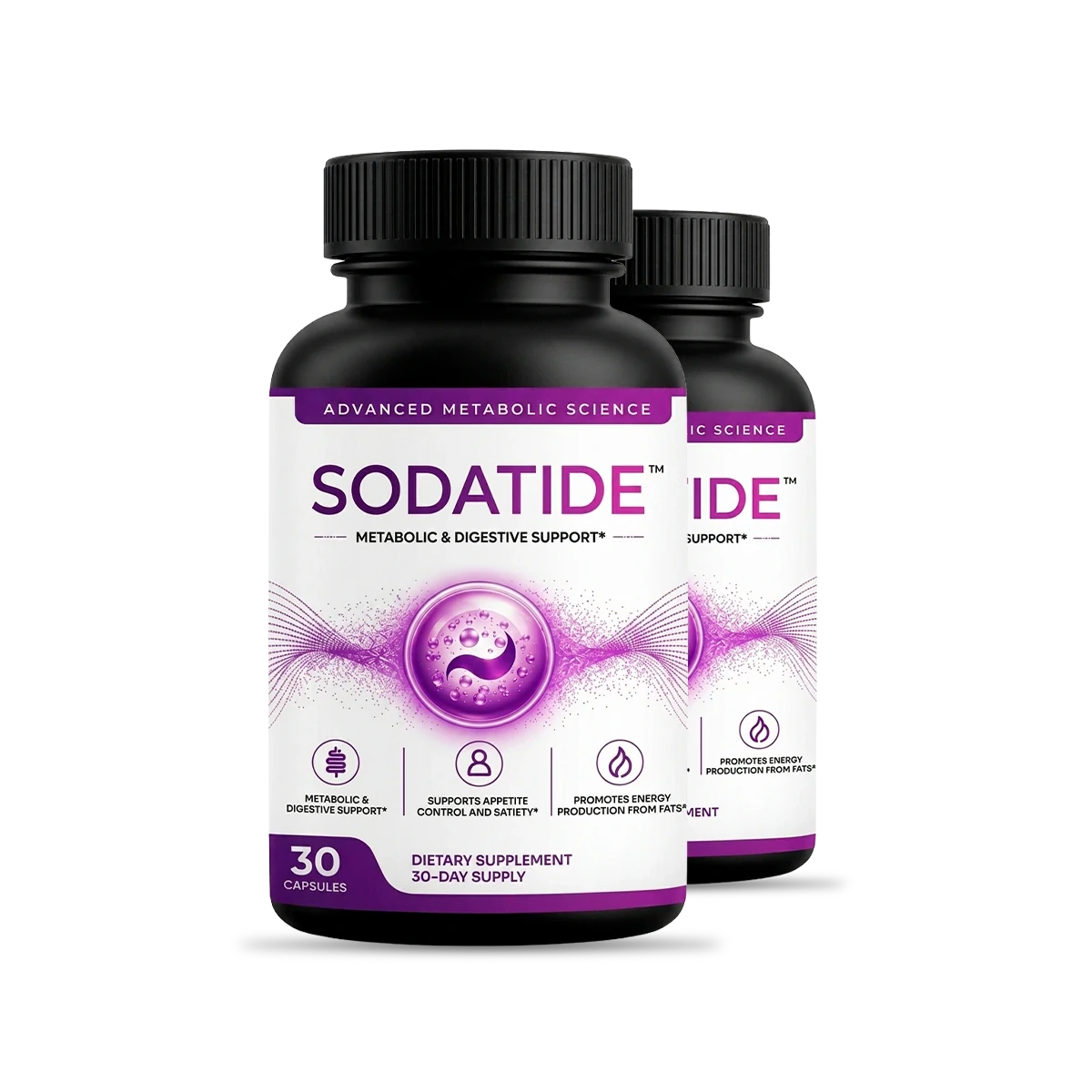
See how SodaTide sits against all of this
One capsule a day of a fermentable fibre and live cultures, with the amounts the trials used printed beside each ingredient.
Two bottles $158 · six bottles $294 · 60-day money-back guarantee
Order SodaTide On The Official WebsiteOne capsule a day · 30 per bottle · lot SOD-26/SO-5430