SodaTide Official Website › Ingredients
IngredientsSodaTide Ingredients: Chicory Root Inulin, Potato Resistant Starch and a Probiotic Blend
SodaTide names three ingredients on the front of the bottle.
Chicory root inulin and potato resistant starch are fibres human enzymes cannot break down, so they reach the large intestine and are fermented there. The third is a probiotic blend, described as a blend rather than by organism. The artwork carries no weight against any of the three.
Three names, what each one is, and the amount every published trial of it actually used.
The three ingredients on the SodaTide label, in the vendor's own order
Chicory Root Inulin
Cichorium intybusTrials: 8–21 g/dayInulin is a chain of fructose units with a glucose cap, stored by chicory in its root the way a potato stores starch. The bond between those units is one human digestive enzymes have no key for, which is the whole reason it is interesting: it arrives in the colon intact and the bacteria there eat it.
It is the most studied prebiotic fibre there is. The ISAPP consensus definition was written largely around this class of compound. A dose-response study in 200 volunteers raised faecal bifidobacteria at 2.5, 5, 7.5 and 10 grams a day, with the effect larger at the top of that range. A 12-week trial at 21 grams a day recorded lower ghrelin, higher peptide YY and about a kilogram of weight change against a placebo that gained half of one. A 16-week trial in children used 8 grams a day and measured body fat directly.
The pooled picture is more modest than any single trial. The 2024 chicory inulin meta-analysis is the reference point for weight outcomes; a 2021 pooled analysis and a 2017 one cover weight, glucose and lipids together. For glucose specifically, a dose-response review in prediabetes and type 2 diabetes is the one to read.
What the bottle gives you is the name. The amount is a matter for the label section below rather than for this card.
Potato Resistant Starch
Solanum tuberosumTrials: 3.5–48 g/dayResistant starch is starch that gets past the small intestine. Potato starch in its raw, ungelatinised form is one of the densest natural sources of it, which is why it turns up in supplements rather than the cooked kind.
The dose literature here is wider and less settled than inulin's. A 2024 analysis of resistant potato starch tested 3.5 grams a day for one and four weeks and states in its own background that the prebiotic effects of resistant starches are linked to intakes above 15 grams a day. An acute appetite crossover used 48 grams across two meals. A potato side-dish trial added the starch as food, shifted the gut microbiota and found no change in faecal short-chain fatty acid concentrations, which is a useful reminder that measuring the output is harder than measuring the input.
Pooled: a glycaemic-control meta-analysis and a review in metabolic syndrome both report small effects that depend heavily on who was studied. One study looked specifically at variability and found the microbiome response to resistant starch differs substantially between people, which is the honest answer to why one person notices something and another does not.
Probiotic Blend
Blend named; no strains, no countA probiotic is defined as a live micro-organism that confers a health benefit when administered in an adequate amount. The ISAPP consensus statement that sets that out is equally clear that both halves are specific: the organism is named at strain level, and the amount is a colony-forming-unit count.
This label gives the category and stops. That is a real limit on what can be said, and this desk will not work round it by describing somebody else's strain as though it were in this capsule.
What the literature shows, when a strain IS named, is worth knowing anyway. The Akkermansia muciniphila study gave 10^10 cells a day for three months to overweight, insulin-resistant volunteers and reported improved insulin sensitivity for the pasteurised form. A 12-week trial of L. gasseri SBT2055 used 200 grams a day of a fermented milk carrying the strain and measured abdominal fat area by scan. A meta-analysis across trials finds small average effects on body fat and cardiovascular markers.
There is also a quality question that applies to the whole category. An audit of commercial probiotic products compared what labels claimed with what the bottles contained and found the two agreed less often than a buyer would assume. A strain list is what makes that checkable.
Why two of the three SodaTide ingredients are fibres and one is bacteria
The combination has a name. The ISAPP synbiotic consensus defines it as a mixture of live micro-organisms and a substrate those organisms use, given together so that the pairing does more than either part alone. A fibre and a culture in one capsule is exactly that shape.
The argument for it is straightforward. Swallowing live bacteria puts a small number of organisms into a colon that already holds an enormous number, and most of what arrives passes through. Supplying something those organisms preferentially grow on is an attempt to tilt that arithmetic, and it also feeds the bacteria already resident, which are far more numerous.
The argument against relying on it too heavily is in the same literature. A trial that tested this directly gave Bifidobacterium strains and galacto-oligosaccharides to adults with obesity, separately and together, and found the combination showed no synergism. Both halves did something; putting them in one product did not multiply it.
- Two prebiotic substrates and one live culture, which is a synbiotic.
- The fibres feed the bacteria already present as well as the ones supplied.
- Synergy between the two halves is assumed more often than it is demonstrated.
- All three effects are dose-dependent, and the dose is where this label stops.
Honest label analysis: what the SodaTide artwork prints and what it leaves open
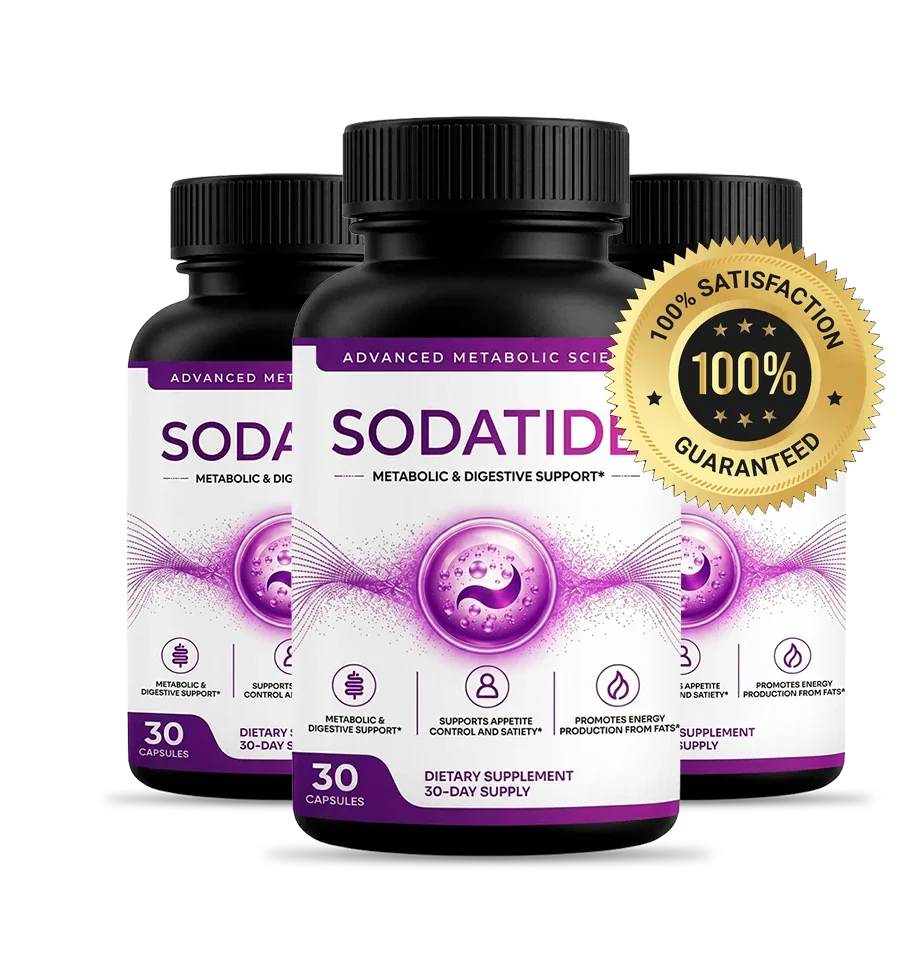
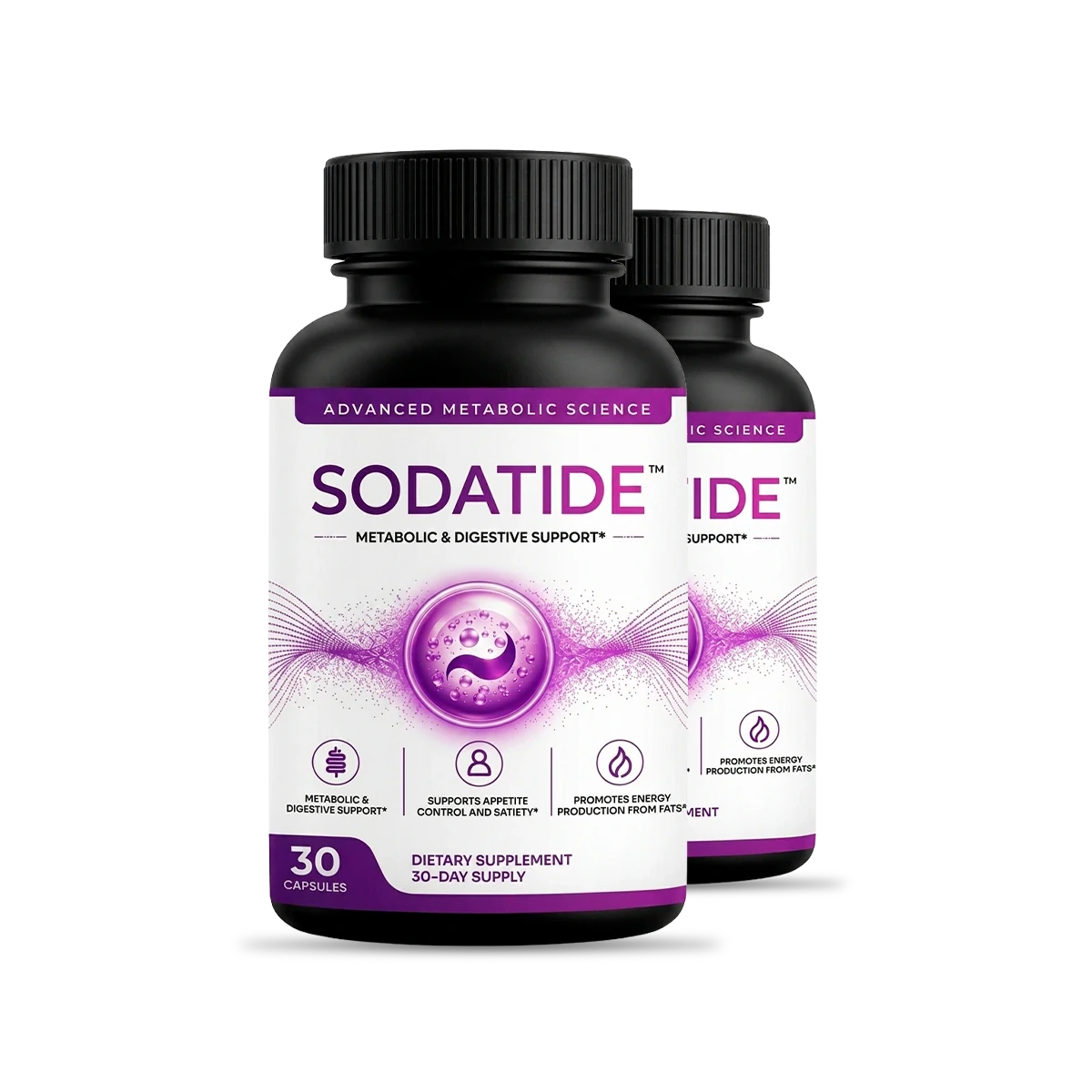
The product images supplied with this site are front-label shots and one ingredient graphic. Between them they give the wordmark, the strapline “Advanced Metabolic Science”, three icon captions, the capsule count, the supply length and the three ingredient names. There is no Supplement Facts panel among them, so there is no serving-size row, no milligram figure, no colony-forming-unit count and no other-ingredients line stating what the capsule shell is made of.
This site carries no supplement-facts page for that reason. Writing one would mean inventing a panel, and an invented panel is worse than an absent one because it looks checkable.
The table is the comparison, and it is worth reading slowly. Every amount in the right-hand column is a gram figure. One capsule is a container measured in hundreds of milligrams, and it holds three things rather than one. Whatever the split between them, the daily contribution here is an order of magnitude below the amounts on the right.
That does not make the ingredients wrong and it does not make the product pointless. Fibre intake in most Western diets sits well below what the Lancet series on carbohydrate quality associates with lower disease risk, and a daily contribution is a daily contribution. It does mean a buyer should expect a nudge rather than a trial result, and should hold the seller's more colourful language at arm's length.
The seller's own information page describes the blend as turning a gut into a fat-burning machine and names Akkermansia muciniphila as an example strain. Neither statement survives onto this site: the first has no trial behind it in any of the three ingredients' literature, and the second describes an organism the bottle does not name. The full list of refusals is in this site's citation file and summarised on the benefits page.
What a buyer can check about SodaTide without a panel
| Question | Answer from the bottle | How to verify it |
|---|---|---|
| What form is it? | Capsule, 30 to a bottle | Printed on the front label and on the vendor's ingredient graphic. |
| How long does a bottle last? | 30 days at one a day | The label prints both the count and the supply length. |
| What is in it? | Three named ingredients | The front label names the category; the INSIDE SODATIDE graphic names all three. |
| How much of each? | The artwork gives names without weights | Nothing to verify. Ask the seller in writing before buying if it matters to you. |
| Which strains? | A blend, unnamed | Nothing to verify. A strain list is the only thing that would make it checkable. |
| What is the shell made of? | The artwork carries no other-ingredients line | Read the bottle you receive. Anyone avoiding gelatin should do this before the first capsule. |
| Which batch is mine? | Lot and best-before on the base | Lot SOD-26/SO-5430. Call +1 (302) 200-3480 to match an order to a batch. |
Seven questions a careful buyer asks. Four of them this artwork answers.
Two of the unanswered rows have a practical workaround and one does not. The shell is settled by reading the bottle in your hand. The batch is settled by the order desk. The amount is settled by nothing available to a buyer, which is why the section above prints the trial doses instead.
How this SodaTide page was sourced, and by whom
Twenty-two sources, every one confirmed against its NCBI record during this build. The dose each trial used is part of the citation line, because on this label the dose is the question.
- Gibson GR, Hutkins R, Sanders ME, et al. Expert consensus document: The International Scientific Association for Probiotics and Prebiotics (ISAPP) consensus statement on the definition and scope of prebiotics. Nat Rev Gastroenterol Hepatol. 2017;14(8):491-502. PMID 28611480. https://pubmed.ncbi.nlm.nih.gov/28611480/
- Hill C, Guarner F, Reid G, et al. Expert consensus document. The International Scientific Association for Probiotics and Prebiotics consensus statement on the scope and appropriate use of the term probiotic. Nat Rev Gastroenterol Hepatol. 2014;11(8):506-14. PMID 24912386. https://pubmed.ncbi.nlm.nih.gov/24912386/
- Swanson KS, Gibson GR, Hutkins R, et al. The International Scientific Association for Probiotics and Prebiotics (ISAPP) consensus statement on the definition and scope of synbiotics. Nat Rev Gastroenterol Hepatol. 2020;17(11):687-701. PMID 32826966. https://pubmed.ncbi.nlm.nih.gov/32826966/
- Bouhnik Y, Raskine L, Simoneau G, Paineau D, Bornet F. The capacity of short-chain fructo-oligosaccharides to stimulate faecal bifidobacteria: a dose-response relationship study in healthy humans. Nutr J. 2006;5:8. PMID 16569219. Doses: 2.5, 5.0, 7.5 and 10 g a day for 7 days. https://pubmed.ncbi.nlm.nih.gov/16569219/
- Parnell JA, Reimer RA. Weight loss during oligofructose supplementation is associated with decreased ghrelin and increased peptide YY in overweight and obese adults. Am J Clin Nutr. 2009;89(6):1751-9. PMID 19386741. Dose: 21 g a day for 12 weeks. https://pubmed.ncbi.nlm.nih.gov/19386741/
- Nicolucci AC, Hume MP, Martinez I, et al. Prebiotics Reduce Body Fat and Alter Intestinal Microbiota in Children Who Are Overweight or With Obesity. Gastroenterology. 2017;153(3):711-722. PMID 28596023. Dose: 8 g a day of oligofructose-enriched inulin for 16 weeks. https://pubmed.ncbi.nlm.nih.gov/28596023/
- Reimer RA, Soto-Vaca A, Nicolucci AC, et al. The effects of chicory inulin-type fructans supplementation on weight management outcomes: systematic review, meta-analysis, and meta-regression of randomized controlled trials. Am J Clin Nutr. 2024;120(4):972-983. PMID 39313030. https://pubmed.ncbi.nlm.nih.gov/39313030/
- Li L, Li P, Xu L. Assessing the effects of inulin-type fructan intake on body weight, blood glucose, and lipid profile: A systematic review and meta-analysis of randomized controlled trials. Food Sci Nutr. 2021;9(8):4598-4616. PMID 34401107. https://pubmed.ncbi.nlm.nih.gov/34401107/
- Liu F, Prabhakar M, Ju J, Long H, Zhou HW. Effect of inulin-type fructans on blood lipid profile and glucose level: a systematic review and meta-analysis of randomized controlled trials. Eur J Clin Nutr. 2017;71(1):9-20. PMID 27623982. https://pubmed.ncbi.nlm.nih.gov/27623982/
- Wang L, Yang H, Huang H, et al. Inulin-type fructans supplementation improves glycemic control for the prediabetes and type 2 diabetes populations: results from a GRADE-assessed systematic review and dose-response meta-analysis of randomized controlled trials. J Transl Med. 2019;17(1):410. PMID 31805963. https://pubmed.ncbi.nlm.nih.gov/31805963/
- Bush JR, Han J, Deehan EC, et al. Resistant Potato Starch Supplementation Reduces Serum Free Fatty Acid Levels and Influences Bile Acid Metabolism. Metabolites. 2024;14(10):536. PMID 39452917. Dose: 3.5 g a day; the paper notes that the prebiotic and metabolic effects of resistant starches are linked to intakes above 15 g a day. https://pubmed.ncbi.nlm.nih.gov/39452917/
- Al-Mana NM, Robertson MD. Acute Effect of Resistant Starch on Food Intake, Appetite and Satiety in Overweight/Obese Males. Nutrients. 2018;10(12):1993. PMID 30558330. Dose: 48 g of resistant starch across breakfast and lunch. https://pubmed.ncbi.nlm.nih.gov/30558330/
- DeMartino P, Johnston EA, Petersen KS, Kris-Etherton PM, Cockburn DW. Additional Resistant Starch from One Potato Side Dish per Day Alters the Gut Microbiota but Not Fecal Short-Chain Fatty Acid Concentrations. Nutrients. 2022;14(4):721. PMID 35277080. https://pubmed.ncbi.nlm.nih.gov/35277080/
- Venkataraman A, Sieber JR, Schmidt AW, et al. Variable responses of human microbiomes to dietary supplementation with resistant starch. Microbiome. 2016;4(1):33. PMID 27357127. https://pubmed.ncbi.nlm.nih.gov/27357127/
- Xiong K, Wang J, Kang T, et al. Effects of resistant starch on glycaemic control: a systematic review and meta-analysis. Br J Nutr. 2021;125(11):1260-1269. PMID 32959735. https://pubmed.ncbi.nlm.nih.gov/32959735/
- Halajzadeh J, Milajerdi A, Reiner Z, et al. Effects of resistant starch on glycemic control, serum lipoproteins and systemic inflammation in patients with metabolic syndrome and related disorders: A systematic review and meta-analysis of randomized controlled clinical trials. Crit Rev Food Sci Nutr. 2020;60(18):3172-3184. PMID 31661295. https://pubmed.ncbi.nlm.nih.gov/31661295/
- Depommier C, Everard A, Druart C, et al. Supplementation with Akkermansia muciniphila in overweight and obese human volunteers: a proof-of-concept exploratory study. Nat Med. 2019;25(7):1096-1103. PMID 31263284. Dose: 10^10 live or pasteurised cells a day for three months. https://pubmed.ncbi.nlm.nih.gov/31263284/
- Kadooka Y, Sato M, Imaizumi K, et al. Regulation of abdominal adiposity by probiotics (Lactobacillus gasseri SBT2055) in adults with obese tendencies in a randomized controlled trial. Eur J Clin Nutr. 2010;64(6):636-43. PMID 20216555. Dose: 200 g a day of fermented milk carrying the strain, for 12 weeks. https://pubmed.ncbi.nlm.nih.gov/20216555/
- Pontes KSDS, Guedes MR, Cunha MRD, et al. Effects of probiotics on body adiposity and cardiovascular risk markers in individuals with overweight and obesity: A systematic review and meta-analysis of randomized controlled trials. Clin Nutr. 2021;40(8):4915-4931. PMID 34358838. https://pubmed.ncbi.nlm.nih.gov/34358838/
- Weese JS, Martin H. Assessment of commercial probiotic bacterial contents and label accuracy. Can Vet J. 2011;52(1):43-6. PMID 21461205. https://pubmed.ncbi.nlm.nih.gov/21461205/
- Krumbeck JA, Rasmussen HE, Hutkins RW, et al. Probiotic Bifidobacterium strains and galactooligosaccharides improve intestinal barrier function in obese adults but show no synergism when used together as synbiotics. Microbiome. 2018;6(1):121. PMID 29954454. https://pubmed.ncbi.nlm.nih.gov/29954454/
- Reynolds A, Mann J, Cummings J, et al. Carbohydrate quality and human health: a series of systematic reviews and meta-analyses. Lancet. 2019;393(10170):434-445. PMID 30638909. https://pubmed.ncbi.nlm.nih.gov/30638909/
Order SodaTide from the official U.S. shop
Three named ingredients, one capsule a day, thirty to a bottle. Buying here is what puts the order inside the sixty-day window this desk administers.
Two bottles $158 · six bottles $294 · 60-day money-back guarantee
Order SodaTide On The Official WebsiteOne capsule a day · 30 per bottle · lot SOD-26/SO-5430