SodaTide Official Website › Blog › Chicory Root Inulin
Chicory Root Inulin: What 8, 16 And 21 Grams A Day Actually Did
Chicory inulin is the best-documented prebiotic fibre there is, and almost everything published about it was done at doses you could weigh on a kitchen scale. Here is what each of those amounts produced, what the pooled analyses say, and why the dose is the only part of the story that matters on a capsule label.
What inulin is, chemically
Inulin is a fructan: a chain of fructose units with a glucose unit on the end, stored by certain plants as their carbohydrate reserve the way a potato stores starch. Chicory root is the commercial source because it is unusually rich in it.
The bond joining those fructose units is a beta bond, and human digestive enzymes have no key for it. That is the entire basis of the ingredient. It reaches the large intestine unchanged and is fermented there by bacteria that do have the enzymes, principally bifidobacteria.
Shorter chains are usually sold as oligofructose or fructo-oligosaccharide; longer ones as native or long-chain inulin. Most of the published trials use one or the other and the distinction matters for tolerance more than for mechanism.
- Inulin: the general term for the fructan, and for longer chains.
- Oligofructose: shorter chains, often produced by partial hydrolysis of inulin.
- Fructo-oligosaccharide, or FOS: the same shorter chains under another name.
- Inulin-type fructans: the umbrella term the meta-analyses use for all of it.
The four doses in the literature
What makes this ingredient unusual is that the dose-response relationship has actually been measured, rather than assumed. Four amounts recur.
| Dose | Study | Length | What was measured |
|---|---|---|---|
| 2.5–10 g a day | Dose-response study in healthy volunteers | 7 days | Faecal bifidobacteria rose at every dose tested, with the effect larger at the top of the range |
| 8 g a day | Oligofructose-enriched inulin in children with obesity | 16 weeks | Body weight z-score, percent body fat and percent trunk fat, all lower against placebo |
| 16 g a day | Oligofructose in healthy adults | Crossover | Total daily energy intake about 5 per cent lower during the fibre period |
| 21 g a day | Oligofructose in overweight and obese adults | 12 weeks | About 1 kg of weight reduction against a control group that gained about 0.45 kg, with lower ghrelin and higher peptide YY |
Doses and outcomes as the papers report them. All four were randomised.
Two things stand out. The first is that even the lowest dose in that table, 2.5 grams a day, is a quantity you would notice measuring out. The second is that the outcome you would most want, a change in body composition, came from the longest and the largest studies.
What happens when you pool it
Individual trials are encouraging and pooled analyses are more sober, which is the normal pattern in nutrition research and worth knowing before reading any single result too warmly.
The 2024 chicory inulin meta-analysis is the reference point for weight management outcomes specifically, and it is a systematic review, meta-analysis and meta-regression rather than a single trial. Anyone using inulin evidence to make a decision should read that paper rather than the 12-week study on its own.
The general shape of the pooled literature on inulin-type fructans is small, real effects that depend on the dose, the duration and the population studied. That is a more useful summary than either the enthusiastic version or the dismissive one.
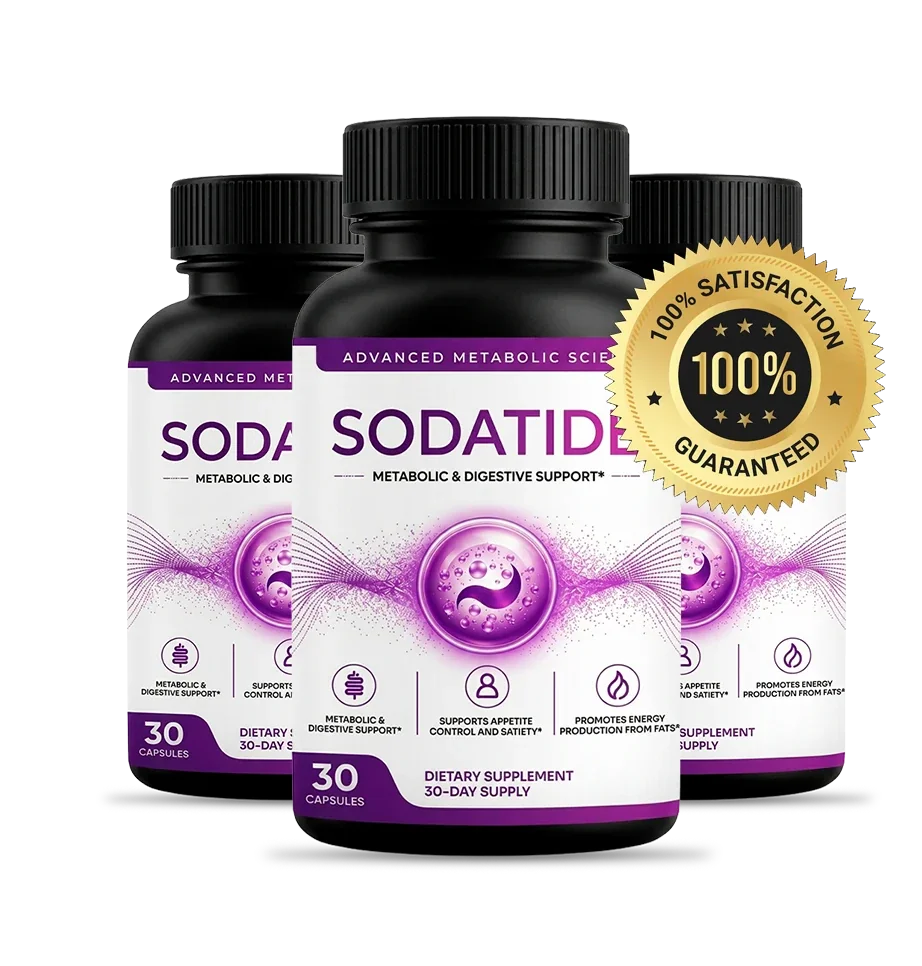
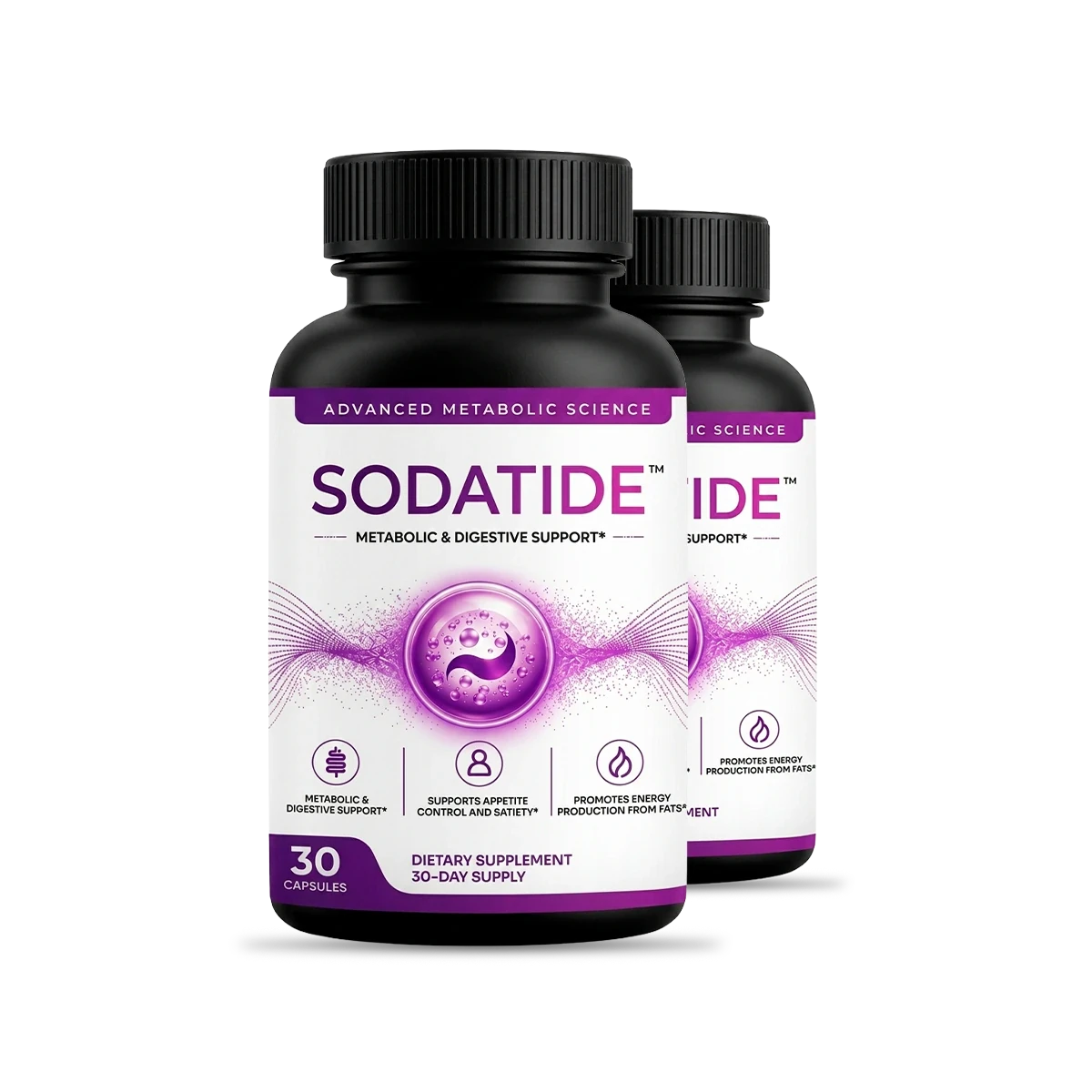
SodaTide names chicory root inulin on the front of the bottle
The artwork gives the name without a weight, so the ingredients page prints every trial dose beside it instead. Sixty days to decide, opened bottles included.
Two bottles $158 · six bottles $294 · 60-day money-back guarantee
Order SodaTide On The Official WebsiteOne capsule a day · 30 per bottle · lot SOD-26/SO-5430
What inulin does that is not about weight
Weight is the outcome that sells this ingredient and it is neither the fastest nor the best documented of the things it does. Three others are worth knowing about, partly because they are more likely to be what a buyer actually notices.
The first is bowel habit. It is the outcome closest to the mechanism, it moves within a few weeks rather than a few months, and it has been studied with stool frequency and consistency as the primary outcomes rather than as an afterthought.
The second is the bacterial population itself. This is the outcome with the cleanest dose-response data anywhere in the field, measured in a stool sample rather than in how anybody felt, and it is why inulin is the reference prebiotic against which others are described.
The third is what happens to blood glucose after a meal containing it, which is a food-formulation question more than a supplement one: replacing sugar with inulin-type fructans in a product lowers the glycaemic response to that product.
- Bowel habit: the fastest observable, within two to four weeks.
- Bifidobacteria counts: the cleanest dose-response data in the field.
- Postprandial glucose: a formulation effect, measured when inulin replaces sugar in a food.
- Appetite and energy intake: slower, and the subject of the trials in the table above.
- Weight: the slowest and the most conditional of the five.
How much people can actually take
A tolerance study in healthy young adults concluded that up to 10 grams a day of native inulin, and up to 5 grams a day of oligofructose, were well tolerated. That is the practical upper end for a product somebody has to take every morning without thinking about it.
There is also a finding that runs against intuition. The 200-volunteer dose-response study reported that bloating was significantly more intense at 2.5 and 5 grams a day than at 7.5 and 10. The usual response to an uncomfortable first week, halving the amount, is not obviously supported by that result.
- Up to 10 g a day of native inulin: well tolerated in healthy young adults.
- Up to 5 g a day of oligofructose: the same conclusion, at a lower figure.
- Bloating was more intense at 2.5 and 5 g a day than at 7.5 and 10 g a day.
- Gas symptoms usually settle within two to three weeks of a steady intake.
Why the dose is the whole question here
Everything above is about an ingredient. SodaTide is a capsule, and a capsule is a container of a few hundred milligrams holding three things rather than one.
The artwork supplied with this product is a front label: a wordmark, a strapline, three icon captions, a capsule count and a supply length. There is no Supplement Facts panel among the images, so there is no weight against chicory inulin and no way for a buyer to place this capsule anywhere on the dose table above.
This desk will not estimate the figure. What it does instead is print the trial amounts beside the ingredient name on the ingredients page and let the reader see the distance. The honest conclusion is that a once-daily capsule is a daily contribution rather than a trial dose, and should be judged on that basis.
Chicory root inulin has genuinely good evidence, and all of it is at amounts a single capsule cannot hold. Both halves of that sentence are true at the same time.
Three questions the trials do not answer
A deep-dive that only reports findings is only half a deep-dive. Three questions about this ingredient remain genuinely open, and a reader is better served knowing which they are.
Does chain length matter?
Short chains and long chains are fermented at different rates and in different parts of the colon, and trials use both without always treating the distinction as important. Whether a buyer should prefer one is not settled, and any label declaring a preference is ahead of the evidence.
How long does an effect persist after stopping?
Almost every trial measures an endpoint while supplementation is still running. What happens to the bacterial population, and to whatever followed from it, a month after the last dose is far less studied. The honest assumption is that a substrate-driven shift depends on the substrate continuing to arrive.
Who responds and who does not?
Averages across a trial population conceal individuals. The variability work in this field is clearer for resistant starch than for inulin, but there is no reason to think inulin responses are uniform, and no way to predict from the outside which kind of responder somebody is.
The same fibre, from food
A guide that never mentions the alternative is not much of a guide. Inulin is a food component before it is a supplement ingredient, and several ordinary foods carry it in the amounts the trials used.
- Chicory root itself, which is where the commercial ingredient comes from.
- Jerusalem artichoke, one of the richest common sources.
- Onions, leeks and garlic, in smaller amounts but eaten more often.
- Asparagus and the white part of a leek.
- Wheat, which contributes a surprising share of total fructan intake in a Western diet simply because of how much of it people eat.
The argument for a capsule is not that it beats food on dose, because it cannot. It is compliance: a capsule gets taken, and a plan to eat more Jerusalem artichokes usually does not survive a fortnight. Whether that trade is worth $49 to $79 a bottle is a question the pricing page tries to set out honestly rather than answer for you.
SodaTide is a dietary supplement, not a drug. Nothing on this page treats, cures or prevents anything, and nothing here is medical advice. A persistent change in bowel habit, unexplained weight change, blood, pain or fever are reasons to be assessed by a clinician rather than reasons to start a capsule.
References
- Parnell JA, Reimer RA, 2009: “Weight loss during oligofructose supplementation is associated with decreased ghrelin and increased peptide YY in overweight and obese adults” in Am J Clin Nutr 89(6):1751-9, PubMed ID 19386741 (Dose 21 g a day for 12 weeks) — PubMed entry
- Cani PD, Joly E, Horsmans Y, Delzenne NM, 2006: “Oligofructose promotes satiety in healthy human: a pilot study” in Eur J Clin Nutr 60(5):567-72, PubMed ID 16340949 (Dose 8 g twice a day, 16 g a day in total) — PubMed entry
- Nicolucci AC, Hume MP, Martinez I, et al, 2017: “Prebiotics Reduce Body Fat and Alter Intestinal Microbiota in Children Who Are Overweight or With Obesity” in Gastroenterology 153(3):711-722, PubMed ID 28596023 (Dose 8 g a day of oligofructose-enriched inulin for 16 weeks) — PubMed entry
- Bouhnik Y, Raskine L, Simoneau G, Paineau D, Bornet F, 2006: “The capacity of short-chain fructo-oligosaccharides to stimulate faecal bifidobacteria: a dose-response relationship study in healthy humans” in Nutr J 5:8, PubMed ID 16569219 (Doses 2.5, 5.0, 7.5 and 10 g a day for 7 days) — PubMed entry
- Reimer RA, Soto-Vaca A, Nicolucci AC, et al, 2024: “The effects of chicory inulin-type fructans supplementation on weight management outcomes: systematic review, meta-analysis, and meta-regression of randomized controlled trials” in Am J Clin Nutr 120(4):972-983, PubMed ID 39313030 — PubMed entry
- Bonnema AL, Kolberg LW, Thomas W, Slavin JL, 2010: “Gastrointestinal tolerance of chicory inulin products” in J Am Diet Assoc 110(6):865-8, PubMed ID 20497775 (Up to 10 g a day of native inulin and up to 5 g a day of oligofructose were well tolerated in healthy young adults) — PubMed entry