SodaTide Official Website › Blog › Resistant Starch
Resistant Starch Is Not Just Fibre, And Potato Starch Is Not Potatoes
The second ingredient on this label is the one most often misunderstood. Resistant starch is starch that behaves like fibre, it comes in at least four distinct types, and the dose literature is wider and less settled than inulin’s. Here is what it is, what the trials used, and why one paper found nothing where everyone expected something.
What makes a starch resistant
Starch is a chain of glucose units and the human body is extremely good at taking it apart. Resistant starch is the fraction that escapes that process in the small intestine and reaches the colon intact, where it is fermented by gut bacteria in the same way a prebiotic fibre is.
Resistance comes from physical structure rather than from a different chemistry. A granule can be too tightly packed for enzymes to penetrate, a starch can be physically enclosed inside an intact plant cell wall, or a cooked starch can recrystallise on cooling into a form enzymes handle poorly.
The standard review of colonic function covers what happens next, and it is the same story as inulin: fermentation produces acetate, propionate and butyrate, which are absorbed and used, with butyrate consumed by the cells lining the colon itself.
Four types, and which one this is
| Type | What it is | Everyday example |
|---|---|---|
| RS1 | Starch physically enclosed in intact plant structures | Whole or coarsely milled grains and seeds |
| RS2 | Native granules too tightly packed for enzymes to enter | Raw potato starch, green banana, high-amylose maize |
| RS3 | Retrograded starch, recrystallised after cooking and cooling | Cooked and cooled potato, rice or pasta |
| RS4 | Chemically modified starches | Industrial food ingredients |
A standard classification. Potato starch supplements are type 2 in their raw form and lose that resistance if cooked.
Potato resistant starch, as a supplement ingredient, is raw and ungelatinised. That is why it is a powder rather than food, and it is also why heat is its enemy: cooking a type 2 starch gelatinises it and it stops being resistant. This is one reason not to tip a capsule into a hot drink, quite apart from the live cultures.
It is also why the ingredient is not the same as eating a potato. A hot boiled potato contains very little resistant starch. The same potato cooked and then cooled contains considerably more, as type 3, which is a different physical form arrived at by a different route.
The dose range in the literature
This is where resistant starch differs most from inulin. The inulin literature clusters around 8 to 21 grams a day. The resistant starch literature is spread much wider, and the papers disagree about where the useful range begins.
| Dose | Study | What was measured |
|---|---|---|
| 3.5 g a day | Resistant potato starch, one and four weeks | Serum free fatty acids and bile acid metabolism. The paper's own background notes that prebiotic effects of resistant starches are linked to intakes above 15 g a day |
| One potato side dish a day | Added resistant starch from food | The gut microbiota shifted; faecal short-chain fatty acid concentrations did not |
| 48 g across two meals | Acute crossover in overweight and obese men | Food intake, appetite and satiety after a test breakfast and lunch |
Three studies, three very different amounts. The spread is the point.
The low-dose analysis is the one worth reading most carefully, because it states the threshold question explicitly rather than leaving it to inference. Its own framing is that the metabolic effects of resistant starches are associated with intakes above 15 grams a day, and it set out to look at what happens at 3.5.
A glycaemic-control meta-analysis pools the trials that measured blood glucose outcomes. As with inulin, the pooled picture is smaller and more conditional than any individual encouraging result.
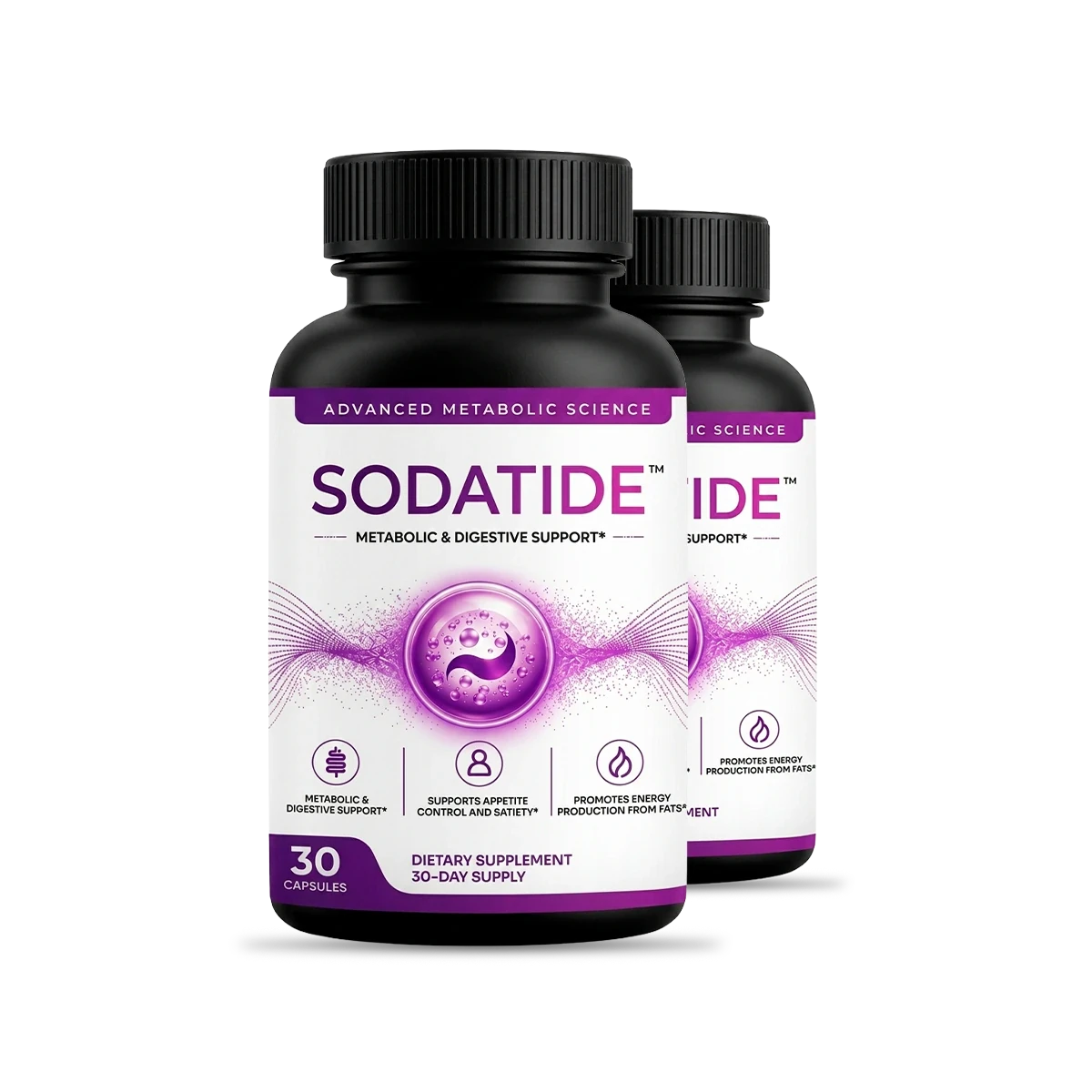
Potato resistant starch is the second name on the SodaTide label
The ingredients page sets it beside the full dose range above, including the paper that puts the metabolic threshold at 15 grams a day.
Two bottles $158 · six bottles $294 · 60-day money-back guarantee
Order SodaTide On The Official WebsiteOne capsule a day · 30 per bottle · lot SOD-26/SO-5430
Where the fermentation products go
Resistant starch has a reputation for being the more butyrate-forming of the two substrates on this label, and it is worth knowing what that means before treating it as a selling point.
Butyrate is the short-chain fatty acid used by the cells lining the colon themselves. It is consumed locally rather than travelling, which is why it is associated with the health of the colonic lining rather than with circulating metabolic effects. Acetate and propionate reach the liver and the bloodstream and are the ones implicated in appetite signalling.
So the two substrates on this bottle are not redundant. A fermentation profile weighted toward butyrate and one weighted toward propionate point at different outcomes, and combining them is a defensible formulation decision even though the amounts remain unstated.
| Product | Where it is used | What it is associated with |
|---|---|---|
| Butyrate | The cells lining the colon | The local health and energy supply of the colonic epithelium |
| Propionate | Liver and circulation | Appetite hormones and energy intake at the next meal |
| Acetate | Circulation and peripheral tissues | The most abundant of the three and the least clearly attributable alone |
As the reviews describe them. None of this is a claim about the finished capsule.
The trial that found nothing, and why it matters
One study added resistant starch to fifty people's diets through an ordinary potato side dish each day and measured two things: what happened to the gut microbiota, and what happened to faecal short-chain fatty acid concentrations. The microbiota changed. The fatty acid concentrations did not.
That result is more useful than a positive one would have been, for two reasons.
The first is methodological. Short-chain fatty acids are produced in the colon and absorbed through its wall, so what appears in a stool sample is what was left over rather than what was made. A measurement that finds nothing may be measuring the wrong thing rather than describing an absent effect.
The second is a caution against tidy mechanistic stories. The chain runs: fibre arrives, bacteria ferment it, fatty acids are produced, hormones respond, appetite changes. Every link in that chain has been demonstrated somewhere, and it does not follow that all of them fire every time in every person.
- Faecal short-chain fatty acids measure what was not absorbed, not what was produced.
- A microbiota shift is easier to detect than a metabolic consequence of one.
- A mechanism demonstrated link by link is not the same as a mechanism demonstrated end to end.
- A null result on a downstream marker is not evidence that nothing happened upstream.
How resistant starch compares with inulin
Both substrates on this label are fermented in the colon and both produce short-chain fatty acids, which makes them sound interchangeable. Four differences are worth holding on to.
- Chemistry. Inulin is a fructan, a chain of fructose. Resistant starch is glucose, in a physical form enzymes cannot open. Same destination, different molecule.
- Fermentation profile. Resistant starch is associated with more butyrate; inulin is the classic bifidogenic substrate. The outcomes those point at are different.
- Dose literature. Inulin clusters at 8 to 21 grams a day. Resistant starch is spread from 3.5 to 48, with the threshold for metabolic effects argued at around 15.
- Tolerance. Resistant starch is generally described as producing less gas than an equivalent weight of inulin, which is one practical argument for combining them rather than doubling either.
The last point is the strongest argument for a two-fibre product. A formulation that reaches a given amount of fermentable substrate through two different molecules, fermented at different rates and in different parts of the colon, is a gentler proposition than the same weight of one of them. Whether that is what is happening inside this particular capsule cannot be established from the label, which is the recurring sentence on this website.
Why two people get different answers
A study designed specifically to examine variability looked at how human microbiomes respond to dietary resistant starch supplementation and found the responses variable between individuals. That is a finding, not a failure of the study.
It also has a practical consequence that no label can address. Two people can take the same capsule for the same eight weeks and reach different conclusions, because they started with different resident bacterial populations and different diets. Neither of them has done anything wrong.
For a buyer this is the strongest argument for the sixty-day window being the actual mechanism of decision. A trial tells you the average effect in a population; only your own eight weeks tells you about you. The timeline page sets out how to run that properly, which mostly means writing things down.
What this means for the bottle
SodaTide names potato resistant starch on the front of the label and the artwork gives no weight against it. Set that beside the dose table above and the honest reading is the same one this site reaches on every ingredient page.
If the useful metabolic range really does begin somewhere above 15 grams a day, as the low-dose paper's own framing suggests, then a share of one capsule is a long way below it. If the digestive and microbiota effects begin lower, which the food study suggests they might, then a daily contribution is a daily contribution.
Both of those can be true at once, and neither can be settled from the outside of this bottle. What a reader can do is understand which questions the label leaves open, which is what the ingredients page is for.
Resistant starch is a physical property rather than a chemical class, it comes in four types and only some of them survive a kitchen, the dose literature is spread from 3.5 to 48 grams a day, and individual responses vary enough that your own eight weeks is the only trial that answers your question.
SodaTide is a dietary supplement, not a drug. Nothing on this page treats, cures or prevents anything, and nothing here is medical advice. A persistent change in bowel habit, unexplained weight change, blood, pain or fever are reasons to be assessed by a clinician rather than reasons to start a capsule.
References
- Bush JR, Han J, Deehan EC, et al, 2024: “Resistant Potato Starch Supplementation Reduces Serum Free Fatty Acid Levels and Influences Bile Acid Metabolism” in Metabolites 14(10):536, PubMed ID 39452917 (Dose 3.5 g a day; the paper notes that the prebiotic and metabolic effects of resistant starches are linked to intakes above 15 g a day) — PubMed entry
- DeMartino P, Johnston EA, Petersen KS, Kris-Etherton PM, Cockburn DW, 2022: “Additional Resistant Starch from One Potato Side Dish per Day Alters the Gut Microbiota but Not Fecal Short-Chain Fatty Acid Concentrations” in Nutrients 14(4):721, PubMed ID 35277080 — PubMed entry
- Al-Mana NM, Robertson MD, 2018: “Acute Effect of Resistant Starch on Food Intake, Appetite and Satiety in Overweight/Obese Males” in Nutrients 10(12):1993, PubMed ID 30558330 (Dose 48 g of resistant starch across breakfast and lunch) — PubMed entry
- Venkataraman A, Sieber JR, Schmidt AW, et al, 2016: “Variable responses of human microbiomes to dietary supplementation with resistant starch” in Microbiome 4(1):33, PubMed ID 27357127 — PubMed entry
- Xiong K, Wang J, Kang T, et al, 2021: “Effects of resistant starch on glycaemic control: a systematic review and meta-analysis” in Br J Nutr 125(11):1260-1269, PubMed ID 32959735 — PubMed entry
- Topping DL, Clifton PM, 2001: “Short-chain fatty acids and human colonic function: roles of resistant starch and nonstarch polysaccharides” in Physiol Rev 81(3):1031-64, PubMed ID 11427691 — PubMed entry