SodaTide Official Website › Blog › Potato Resistant Starch
Potato Resistant Starch: Why Most Of The Trials Behind It Used Corn, Not Potatoes
The label says potato. Open the clinical literature on resistant starch and the plant behind most of it is corn. Here is what the potato-specific human trials actually measured, why the source of a starch changes what it does in the body, and why that gap matters more for this ingredient than it does for the other two names on the bottle.
Resistant starch is a category, not one thing
"Resistant starch" is a functional description, not a single molecule. It means any starch that reaches the large intestine largely undigested by human enzymes, and at least five different structural routes get a starch there. Researchers group them by number, and the numbers matter because they are made differently and behave differently once they arrive.
- Type 1 (RS1): starch physically trapped inside an intact plant cell wall or seed coat, as in whole grains and legumes.
- Type 2 (RS2): starch granules with a dense internal structure that resists enzymes in their raw or minimally cooked state. High-amylose maize is the commercial reference source, and raw potato starch and unripe banana starch also fall in this class.
- Type 3 (RS3): retrograded starch, formed when a cooked starch is cooled and the chains re-crystallise into a harder-to-digest arrangement. This is what happens to a cooked-then-chilled potato.
- Type 4 (RS4): chemically modified starch, cross-linked or substituted so enzymes cannot act on it, made in a food-science lab rather than found as-is in a plant.
- Type 5 (RS5): starch complexed with a fat or fatty acid, a more recently described category studied mostly in food-chemistry papers so far.
A capsule labelled simply "potato resistant starch" does not say which of these routes it uses, or whether it is a blend. That ambiguity is a separate problem this site has covered on the resistant starch types page. This piece asks a different question: whichever type is inside the capsule, how much of the clinical evidence behind "resistant starch" actually used a potato to get there?
Why most trials reach for corn
Search the human trial literature on resistant starch and glycaemic control, and the dominant intervention is high-amylose maize starch, commonly called HAM-RS2, or sold commercially as Hi-Maize. It is a corn product, bred for an unusually high proportion of amylose, the starch fraction that packs into a dense, enzyme-resistant granule.
Three separate human trials make the pattern plain. A 12-week randomised trial in 68 adults with prediabetes used 45 grams a day of high-amylose maize starch against a rapidly digestible starch control. A crossover trial in 24 adults at risk of type 2 diabetes baked 25 grams a day of the same corn-derived starch into bagels. A third trial in 17 people with type 2 diabetes compared high-amylose maize starch, native banana starch and a digestible maize control head-to-head over four days each.
| Trial | Starch source used | People | Length |
|---|---|---|---|
| Prediabetes cardiometabolic trial | High-amylose maize (corn) | 68 | 12 weeks |
| Resistant starch bagels | High-amylose maize (corn) | 24 | 56 days per arm, crossover |
| Type 2 diabetes glycaemic and appetite trial | High-amylose maize and native banana | 17 | 4 days per arm, crossover |
| At-risk-for-diabetes pilot trial | Potato (cooked, then chilled) | 19 | 24 hours per arm, crossover |
Sources and sample sizes as the papers report them.
None of this makes the corn-derived evidence irrelevant to a capsule labelled potato. Amylose is amylose, and the fermentation chemistry downstream of any RS2-type starch has real similarities regardless of the plant it started in. But it does mean that when a seller or a fan site says "resistant starch is well studied," the sentence is doing more work than it looks like, because the plant named in most of that literature is not the one named on this bottle.
The potato-specific human trials
The trial that isolates potato-derived resistant starch specifically, rather than corn or banana, is smaller and its results are more mixed than the corn literature above.
A pilot cross-over trial gave 19 adults with a body mass index of 27 to 39.9 either 300 grams a day of resistant-starch-enriched, cooked-and-chilled potatoes (about 18 grams of resistant starch) or a matched control food, over a single 24-hour period, then measured insulin sensitivity the next morning using the Matsuda index. The result: insulin sensitivity was not significantly different between the potato and control conditions. Fasting glucose was modestly lower, free fatty acids were lower, fullness ratings were lower, and breath hydrogen, a marker of colonic fermentation, was higher after the potato. The authors' own conclusion was that the findings were suggestive and that a larger study was warranted, which is a researcher's way of saying this was not a definitive result.
A trend toward lower fasting insulin that did not reach statistical significance, a significant rise in breath hydrogen confirming that fermentation happened, and an explicit call from the authors for a bigger trial before drawing a firm conclusion. That is the entire human evidence base isolating potato as the resistant starch source, against a metabolic endpoint, as of this review.
The other potato-specific paper in this space is not a human trial at all. A 2024 study induced type 2 diabetes in mice, then fed them a specific fraction called potato resistant starch type 3, and reported improvements in glucose tolerance, inflammation markers and gut bacterial populations, including a rise in Akkermansia muciniphila. That is useful mechanistic work, and it is a mouse model on an induced disease state, not evidence about what a capsule does in an adult human being.
Whole potatoes are a different question again
A third strand of research skips extracted starch altogether and studies whole potatoes as a food. This is worth separating out because a whole potato is not a resistant-starch supplement; it also carries potassium, vitamin C, fibre from the skin, and whatever the potato was cooked in.
A randomised trial in adults with metabolic syndrome added resistant-starch-containing potatoes daily, within a Dietary Guidelines for Americans eating pattern, and found no adverse effect on cardiometabolic risk markers or intestinal permeability, a reassurance about safety rather than a demonstration of benefit. Two smaller acute trials looked at cooking method rather than dose: chilling a boiled potato before eating it lowered the after-meal glucose, insulin and GIP response compared to eating it hot in women with elevated fasting glucose, and a 2026 trial found that a minimally cooked potato improved the glycaemic response across two subsequent meals compared to a more thoroughly cooked one.
Put together, the whole-food potato research says something specific and modest: how you cook and cool a potato changes its resistant starch content and its after-meal glucose effect. That is a real and interesting finding about diet. It is not a finding about a fixed daily dose of extracted potato starch inside a capsule that is not cooked or cooled at your table.
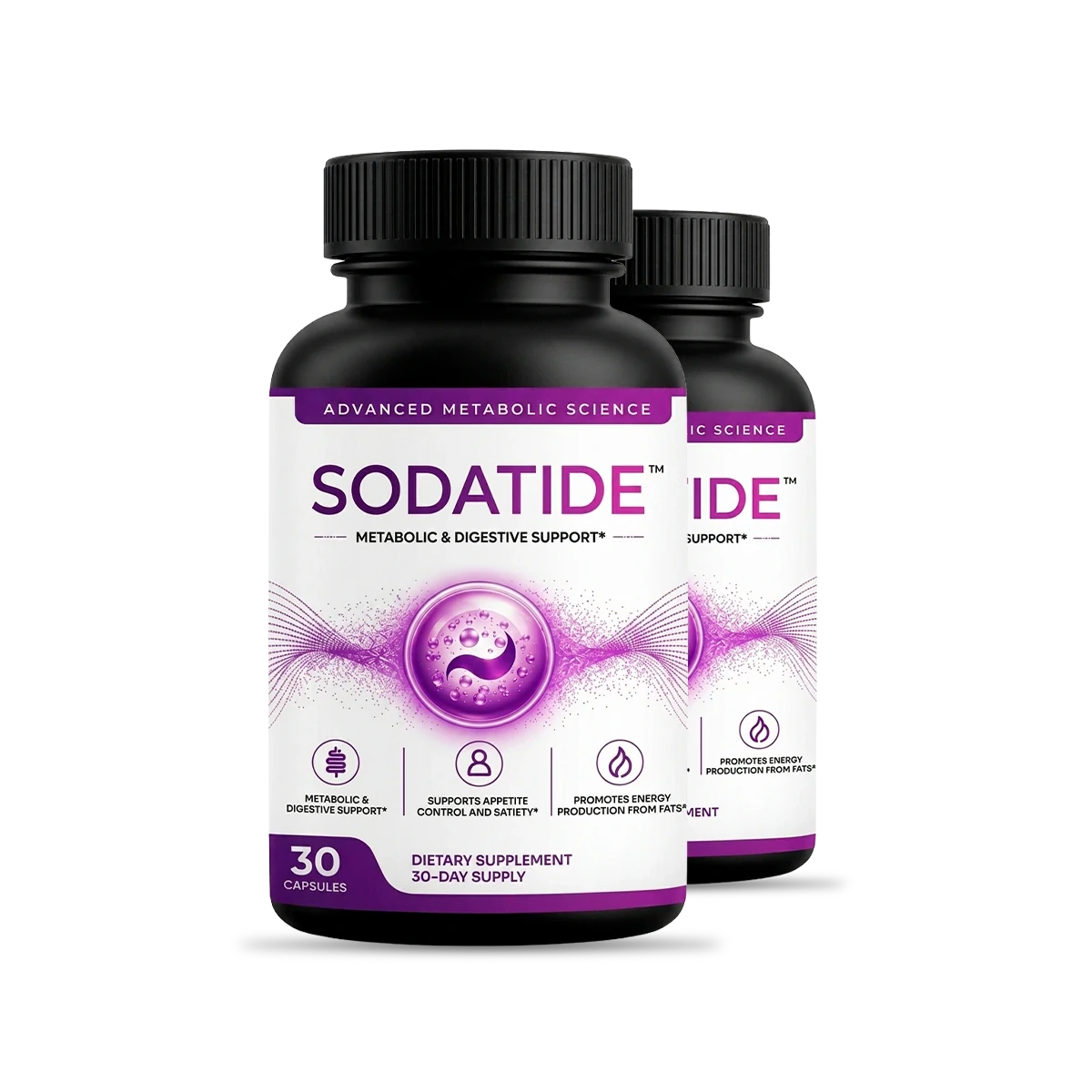
SodaTide names potato resistant starch on the front of the bottle
The artwork gives the plant and no weight, no starch type and no processing method. The ingredients page sets the trial evidence beside the name so a reader can see the gap for themselves.
Two bottles $158 · six bottles $294 · 60-day money-back guarantee
Order SodaTide On The Official WebsiteWhy the source is not a technicality
Three mechanisms make the plant of origin more than a labelling curiosity.
The first is granule structure. Amylose content, granule size and the ratio of amylose to amylopectin differ by plant, and these determine how much of a starch survives to the colon and how quickly it ferments once it gets there. A corn-derived RS2 and a potato-derived RS2 are not chemically identical just because both resist the same digestive enzymes.
The second is what happens after digestion, not just resistance to it. The head-to-head trial above found that native banana starch produced a larger glycaemic benefit than high-amylose maize starch, even though both were dosed to match digestible starch content. If two non-potato sources already behave differently from each other, assuming a potato source behaves like either is an extra, untested step.
The third is fermentation speed and location. Faster-fermenting resistant starches tend to act more in the upper colon and produce more gas sooner; slower-fermenting types act further along and more gradually. The pilot potato trial's rise in breath hydrogen after a single 24-hour exposure is consistent with active, fairly prompt fermentation, but a single small trial is not enough to characterise a fermentation profile with confidence.
What SodaTide's label actually says
The artwork supplied with this product names three ingredients on the front label: chicory root inulin, potato resistant starch and a probiotic blend. There is no Supplement Facts panel among the images this site has to work from, so there is no printed weight, no stated resistant starch type, and no description of how the starch was processed before it went into the capsule.
That leaves a reader with the plant name and nothing else. Given what the trial landscape above actually contains, the honest summary is that "potato resistant starch" on a label points toward a real and legitimate ingredient category with genuine mechanistic support, and toward a comparatively thin, mostly pilot-scale slice of human evidence that isolates the potato source specifically rather than borrowing results from corn or banana starch.
SodaTide is a dietary supplement, not a drug, and resistant starch is a fibre, not a treatment for diabetes or prediabetes. Anyone managing blood glucose with medication should talk to the prescriber before adding a new fermentable fibre, since the trials above were run in people without that medication as a variable being tested.
What nobody has tested yet
Three gaps are worth naming plainly rather than glossing over.
Nobody has run a multi-week trial of extracted potato resistant starch against a corn-derived control at a matched dose.
The head-to-head work that exists compares corn against banana, not corn against potato. Until that trial is run, claims that a potato-sourced capsule ingredient behaves like the much larger corn literature are an extrapolation, a reasonable one, but an extrapolation.
Nobody has published the resistant starch content of a specific capsule against a reference standard.
The pilot potato trial used a food matrix engineered to deliver a known 18 grams; a capsule's contents have not been independently analysed and published in the way this review can point to.
The mouse data on potato resistant starch type 3 has not yet been followed by a human trial using the same fraction.
Mechanistic animal work is a reasonable first step, not a substitute for the human trial that would need to follow it.
References
- Sanders LM, Dicklin MR, Palacios OM, Maki CE, Wilcox ML, Maki KC. Effects of potato resistant starch intake on insulin sensitivity, related metabolic markers and appetite ratings in men and women at risk for type 2 diabetes: a pilot cross-over randomised controlled trial. J Hum Nutr Diet. 2021;34(1):94-105. PMID 33119948. https://pubmed.ncbi.nlm.nih.gov/33119948/
- Peterson CM, Beyl RA, Marlatt KL, Martin CK, Aryana KJ, Marco ML, Martin RJ, Keenan MJ, Ravussin E. Effect of 12 wk of resistant starch supplementation on cardiometabolic risk factors in adults with prediabetes: a randomized controlled trial. Am J Clin Nutr. 2018;108(3):492-501. PMID 30010698. https://pubmed.ncbi.nlm.nih.gov/30010698/
- Dainty SA, Klingel SL, Pilkey SE, McDonald E, McKeown B, Emes MJ, Duncan AM. Resistant Starch Bagels Reduce Fasting and Postprandial Insulin in Adults at Risk of Type 2 Diabetes. J Nutr. 2016;146(11):2252-2259. PMID 27733521. https://pubmed.ncbi.nlm.nih.gov/27733521/
- Garcia-Vazquez C, Ble-Castillo JL, Arias-Cordova Y, Ramos-Garcia M, Olvera-Hernandez V, Guzman-Priego CG, Martinez-Lopez MC, Jimenez-Dominguez G, Hernandez-Becerra JA. Effects of resistant starch on glycemic response, postprandial lipemia and appetite in subjects with type 2 diabetes. Eur J Nutr. 2023;62(5):2269-2278. PMID 37083722. https://pubmed.ncbi.nlm.nih.gov/37083722/
- Liu X, Ma Q, Feng Y, Wang F, Wang W, Wang J, Sun J. Potato resistant starch improves type 2 diabetes by regulating inflammation, glucose and lipid metabolism and intestinal microbial environment. Int J Biol Macromol. 2024;281(Pt 3):136389. PMID 39389507. Mouse model. https://pubmed.ncbi.nlm.nih.gov/39389507/
- Cao S, Shaw EL, Quarles WR, Sasaki GY, Dey P, Hodges JK, Pokala A, Zeng M, Bruno RS. Daily Inclusion of Resistant Starch-Containing Potatoes in a Dietary Guidelines for Americans Dietary Pattern Does Not Adversely Affect Cardiometabolic Risk or Intestinal Permeability in Adults with Metabolic Syndrome: A Randomized Controlled Trial. Nutrients. 2022;14(8):1545. PMID 35458108. https://pubmed.ncbi.nlm.nih.gov/35458108/
- Patterson MA, Fong JN, Maiya M, Kung S, Sarkissian A, Nashef N, Wang W. Chilled Potatoes Decrease Postprandial Glucose, Insulin, and Glucose-dependent Insulinotropic Peptide Compared to Boiled Potatoes in Females with Elevated Fasting Glucose and Insulin. Nutrients. 2019;11(9):2066. PMID 31484331. https://pubmed.ncbi.nlm.nih.gov/31484331/
- Wei J, Fan Z, Deng Y, Pan K, Shi R, Hu J, Liu B. Minimally Cooked Potato Improved Glycemic Response Across Two Meals and Insulin Sensitivity of Rice-Potato Mixed Meals: A Randomized Controlled Acute Trial. Nutrients. 2026;18(6):973. PMID 41901148. https://pubmed.ncbi.nlm.nih.gov/41901148/