SodaTide Official Website › Blog › How Many People Were In These Trials
How Many People Were Actually In These Trials? Sample Sizes Behind SodaTide's Three Ingredients
"Thirty-two studies" sounds like a settled question. So does "a systematic review and meta-analysis." Neither phrase tells you how many people were actually counted, how much the individual trials disagreed with each other, or who paid for the research. All three numbers exist for the pooled evidence behind chicory inulin, potato resistant starch and probiotics, and reading them changes what the headline number is worth.
Why the study count is not the useful number
A systematic review counts studies. A meta-analysis pools their results into one combined estimate. Both numbers get quoted as evidence of how "well studied" an ingredient is, and both numbers hide the three things that actually determine whether a pooled estimate deserves confidence: how many people were in the underlying trials, how much those trials agreed with each other statistically, and whether the result survives being checked without its most influential single study.
That middle measure has a name: heterogeneity, usually reported as I², a percentage. Below about 25 percent, the trials being pooled largely agree and a combined estimate is fairly trustworthy. Above about 75 percent, the trials disagree substantially, and averaging them together produces a number that is real in an arithmetic sense while describing no single trial well. All three ingredient categories below have at least one pooled analysis sitting well above that 75 percent line.
Chicory inulin: 32 studies, 1,184 people, and one funding line
This site's own deep-dive on chicory inulin dosing already points a reader to this same meta-analysis as the reference point for weight-management outcomes. What it does not unpack is what sits inside that reference point once you open it up.
The most current pooled analysis of chicory inulin-type fructans for weight management is a 2024 systematic review, meta-analysis and meta-regression covering 32 eligible studies. For the primary outcome, body weight, it pooled 1,184 people across those studies and found a statistically significant mean reduction of 0.97 kg against placebo. That headline sounds solid, and in one respect it is: 32 trials is a genuinely large literature for a single supplement ingredient.
Two details change how that headline should be read. The first is heterogeneity: for body weight specifically, the paper reports an I² of 73 percent, in the range where trials disagree substantially rather than converging on a consistent effect size. Body fat percentage showed similarly high heterogeneity, at 75 percent. Other outcomes, such as waist circumference, had lower heterogeneity, so the picture is uneven across endpoints rather than uniformly weak.
The second detail is who funded it and who wrote it. Two of the three authors are employed by BENEO, a company that manufactures chicory-derived prebiotic fibre ingredients for the food industry, and the paper's own conflict-of-interest statement says so directly. That does not mean the pooled estimate is wrong. Meta-analyses with industry involvement are common in nutrition science and are not automatically untrustworthy, especially when, as here, the methods and the heterogeneity figures are reported transparently. It does mean a reader deciding how much weight to give a 0.97 kg pooled effect should know that the team assembling it included the ingredient's own manufacturer.
Thirty-two studies, 1,184 people, a real and statistically significant pooled effect on body weight, high disagreement between the individual trials on that specific outcome, and two of three authors employed by a company that sells the ingredient. All five facts are true simultaneously, and a summary that reports only the first two is not inaccurate, just incomplete.
Probiotics and synbiotics: 10 trials, 633 people, and a result that moves when you remove one study
The comparable pooled analysis for probiotics is smaller and its conclusions are more openly tentative. A 2026 systematic review and meta-analysis of probiotic and synbiotic supplementation for body weight management in adults with overweight or obesity included 10 randomised controlled trials totalling 633 participants. Body weight itself showed no significant difference between probiotics and placebo. BMI showed a significant reduction, and fat mass showed a smaller significant reduction, but both of those significant findings carried very high heterogeneity, 84 percent and 57 to 87 percent depending on the outcome.
The authors then did something that most single-ingredient marketing summaries never show a reader: a sensitivity analysis, removing one trial with a known baseline imbalance between groups and re-running the pooled estimate. With that one study removed, the BMI effect dropped to borderline significance and the fat mass effect lost statistical significance entirely. The authors' own conclusion described the findings as "preliminary" and noted that most trials used values measured at the end of the study rather than the change from each person's own starting point, a methodological choice that can bias a pooled estimate in either direction.
| Pooled analysis | Trials | People | Heterogeneity (I²) | Fragility noted by the authors |
|---|---|---|---|---|
| Chicory inulin-type fructans, body weight | 32 studies (overall) | 1,184 | 73% | Two of three authors employed by an ingredient manufacturer |
| Probiotics/synbiotics, BMI | 10 RCTs | 633 | 84% | Effect attenuates to borderline significance without one trial |
| Resistant starch types, glycaemic response | 31 of 36 identified RCTs poolable | 982 | Not uniformly reported; types analysed separately | Only two of five resistant starch types have enough trials to pool |
Figures as the papers report them. Heterogeneity thresholds follow the common convention of roughly 25/50/75 percent for low/moderate/high.
Resistant starch: 31 trials pooled, and a warning about mixing types
Resistant starch adds a complication the other two ingredients do not have to the same degree: it is a category with at least five structurally different subtypes, and pooling them together risks averaging apples with oranges. A 2023 systematic review and meta-analysis identified 36 randomised controlled trials in people with type 2 diabetes or prediabetes, of which 31, covering 982 people, could actually be pooled. Its central finding was that resistant starch types 1 and 2 lowered postprandial glucose in both acute and chronic studies, while resistant starch types 3, 4 and 5 did not have enough trials to support a pooled estimate at all. The authors' own stated conclusion called for more research into those under-studied types before drawing conclusions about them.
That last point connects directly to this site's separate look at where the resistant starch evidence base actually comes from: most of the trials feeding into this pooled analysis used corn-derived resistant starch, and the types with thinner trial counts, including the retrograded RS3 category that a cooked-and-cooled potato produces, are exactly the ones this meta-analysis says are not yet supported by enough pooled data to draw a firm conclusion.
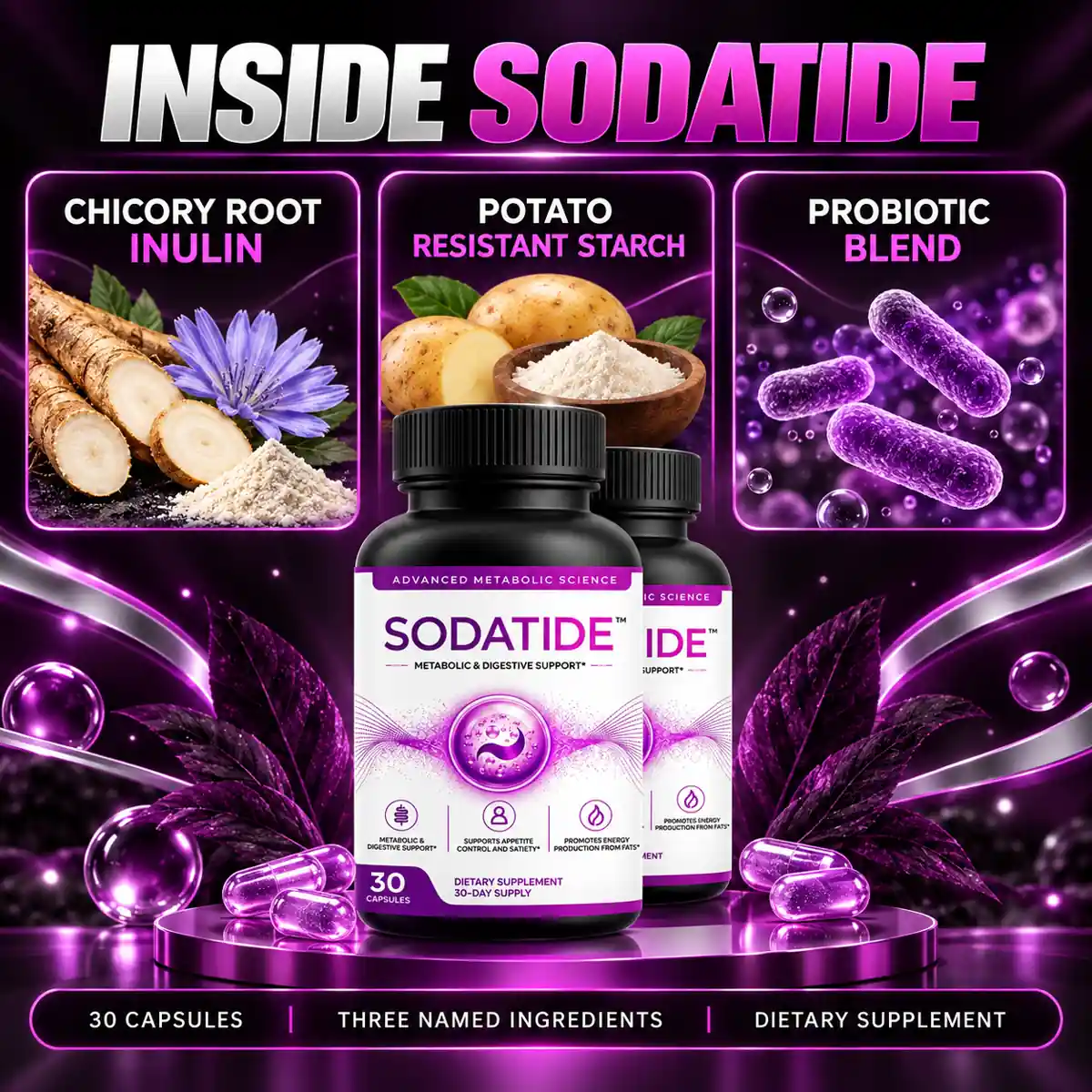
Three names on one label, three different-sized literatures behind them
None of the three pooled analyses above are about this specific capsule; all three are about the ingredient category the label names. The ingredients page keeps that distinction in view rather than folding it into a single confidence score.
Two bottles $158 · six bottles $294 · 60-day money-back guarantee
Order SodaTide On The Official WebsiteWhat a single small trial looks like from the inside
Pooled analyses are built from individual trials, and it is worth looking at what one of those individual trials actually is, because "part of a meta-analysis of hundreds of people" and "a trial of 19 people" describe the same underlying data from different distances. The potato-specific pilot trial referenced elsewhere on this site enrolled 19 adults, ran each condition for 24 hours, and reported its own headline finding, no significant change in insulin sensitivity, as a case for a larger follow-up study, not as a conclusion. A separate 12-week resistant starch trial in 68 adults with prediabetes described itself in its own introduction as "one of the longest trials" attempting to test whether resistant starch improves cardiometabolic health, which is a candid way of saying that even a 12-week, 68-person trial sits at the upper end of what has been attempted in this specific area.
Neither of those numbers, 19 or 68, is a criticism of the researchers, who in both cases described their own sample size limitations plainly in the published paper. It is a reminder that "backed by research" and "backed by a large trial" are not the same claim, and the gap between them is exactly where marketing language tends to round upward.
SodaTide is a dietary supplement, not a drug, and none of the pooled analyses above were conducted on this specific product. They describe the ingredient categories named on the label, at doses and durations the cited papers state, in the populations those papers enrolled.
A short method for reading the next headline number
Four questions turn a headline statistic back into the study it came from.
How many people, not how many studies?
Thirty-two studies pooling 1,184 people averages 37 people per trial. Ten studies pooling 633 people averages 63. Neither average is huge by the standards of drug trials, and the study count alone obscures that.
What was the heterogeneity?
An I² above roughly 75 percent means the individual trials disagreed enough that the pooled number is a statistical average of genuinely different results, not a converging consensus.
Does the result survive a sensitivity analysis?
When authors report what happens after removing one influential trial, as the probiotic meta-analysis above did, and the significant finding disappears, that is the paper telling you directly how fragile its own headline number is.
Who is on the author list, and who paid for it?
A conflict-of-interest statement is printed on nearly every paper cited on this site, and it is worth reading, not because industry involvement invalidates a finding, but because it changes how much independent replication a reader should want before treating the number as settled.
What this means for a capsule with three names
None of the three pooled literatures above is thin in an absolute sense; each represents real, published, peer-reviewed effort involving hundreds to just over a thousand people in total. But none of them is the kind of large, low-heterogeneity, independently replicated evidence base that "clinically studied" implies to most readers either. The honest middle position, which this site has tried to state plainly across its ingredient pages, is that chicory inulin, potato resistant starch and probiotics all have genuine supporting research, that research disagrees with itself more than a single headline number suggests, and a buyer deciding whether to try a capsule naming all three is better served knowing both halves of that sentence.
References
- Reimer RA, Theis S, Zanzer YC. The effects of chicory inulin-type fructans supplementation on weight management outcomes: systematic review, meta-analysis, and meta-regression of randomized controlled trials. Am J Clin Nutr. 2024;120(5):1245-1258. PMID 39313030. https://pubmed.ncbi.nlm.nih.gov/39313030/
- Ko J, Chun J, Yoo C, Gonzalez DE, Lee Y. Effects of probiotics and synbiotics on body weight management in individuals with overweight or obesity: a systematic review and meta-analysis of randomized controlled trials. Phys Act Nutr. 2026;30(2):78-89. PMID 42438848. https://pubmed.ncbi.nlm.nih.gov/42438848/
- Pugh JE, Cai M, Altieri N, Frost G. A comparison of the effects of resistant starch types on glycemic response in individuals with type 2 diabetes or prediabetes: A systematic review and meta-analysis. Front Nutr. 2023;10:1118229. PMID 37051127. https://pubmed.ncbi.nlm.nih.gov/37051127/
- Peterson CM, Beyl RA, Marlatt KL, Martin CK, Aryana KJ, Marco ML, Martin RJ, Keenan MJ, Ravussin E. Effect of 12 wk of resistant starch supplementation on cardiometabolic risk factors in adults with prediabetes: a randomized controlled trial. Am J Clin Nutr. 2018;108(3):492-501. PMID 30010698. https://pubmed.ncbi.nlm.nih.gov/30010698/
- Sanders LM, Dicklin MR, Palacios OM, Maki CE, Wilcox ML, Maki KC. Effects of potato resistant starch intake on insulin sensitivity, related metabolic markers and appetite ratings in men and women at risk for type 2 diabetes: a pilot cross-over randomised controlled trial. J Hum Nutr Diet. 2021;34(1):94-105. PMID 33119948. https://pubmed.ncbi.nlm.nih.gov/33119948/