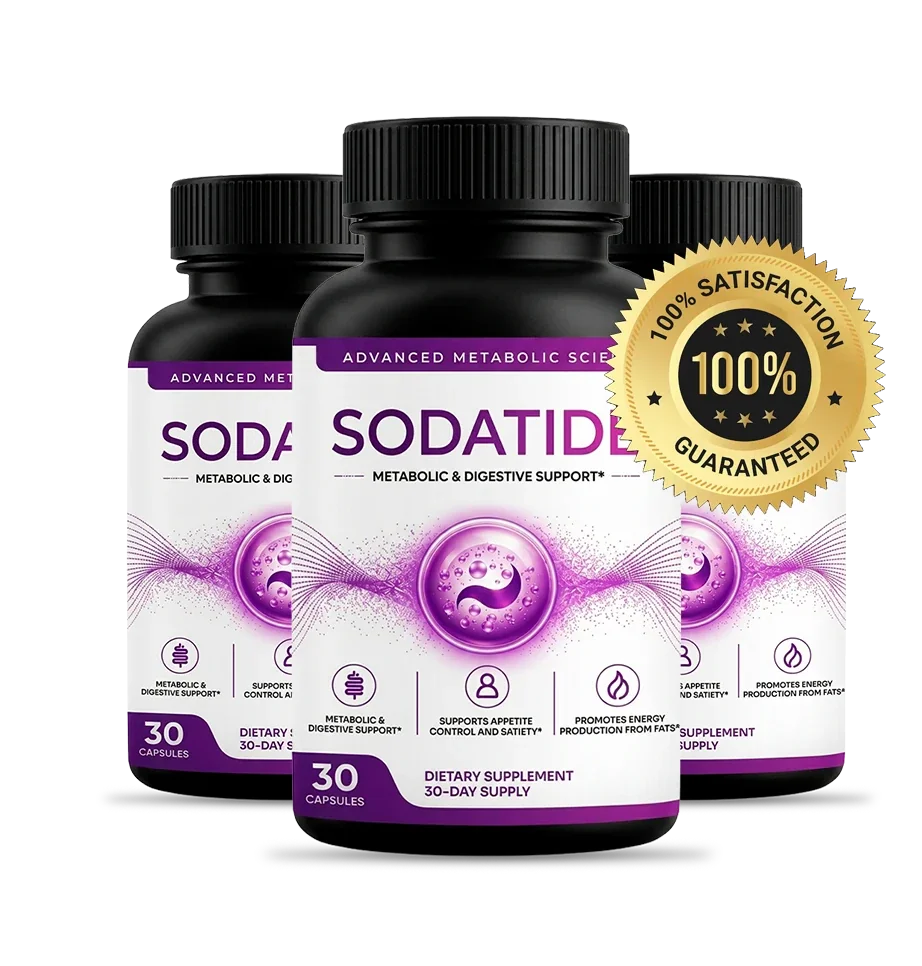
SodaTide Official Website: Synbiotic Capsules for Gut and Metabolism
SodaTide is a synbiotic capsule for gut and metabolism support, taken once a day and sold on the official website. Some people search for it as Soda Tide; the brand spells it SodaTide. Two prebiotic fibres, chicory root inulin and potato resistant starch, share each capsule with a probiotic blend. Gut bacteria ferment that fibre into short-chain fatty acids, while the blend brings live cultures. Adults take one capsule each morning with an 8 oz glass of water and keep the open bottle chilled. There is no stimulant on the label. Buyers here usually judge it after four to eight weeks. One bottle is 30 capsules, a 30-day supply. Every order carries a 60-day money-back guarantee, free US shipping on 3 and 6 bottle packs and no subscription. Dr. Spencer Berry, MD reviewed this page for medical accuracy.
This page covers what the bottle names, how each of those three is thought to work, what the published trials actually used, how long buyers here say they waited, what it costs on the official website and how the 60-day guarantee is claimed.
Free US shipping on 3 & 6 bottles One-time payment, no subscription 60-day money-back guarantee
- One capsule a day
- 30 capsules a bottle
- 3 named ingredients
- 4–8 weeks typical wait
- 60-day guarantee
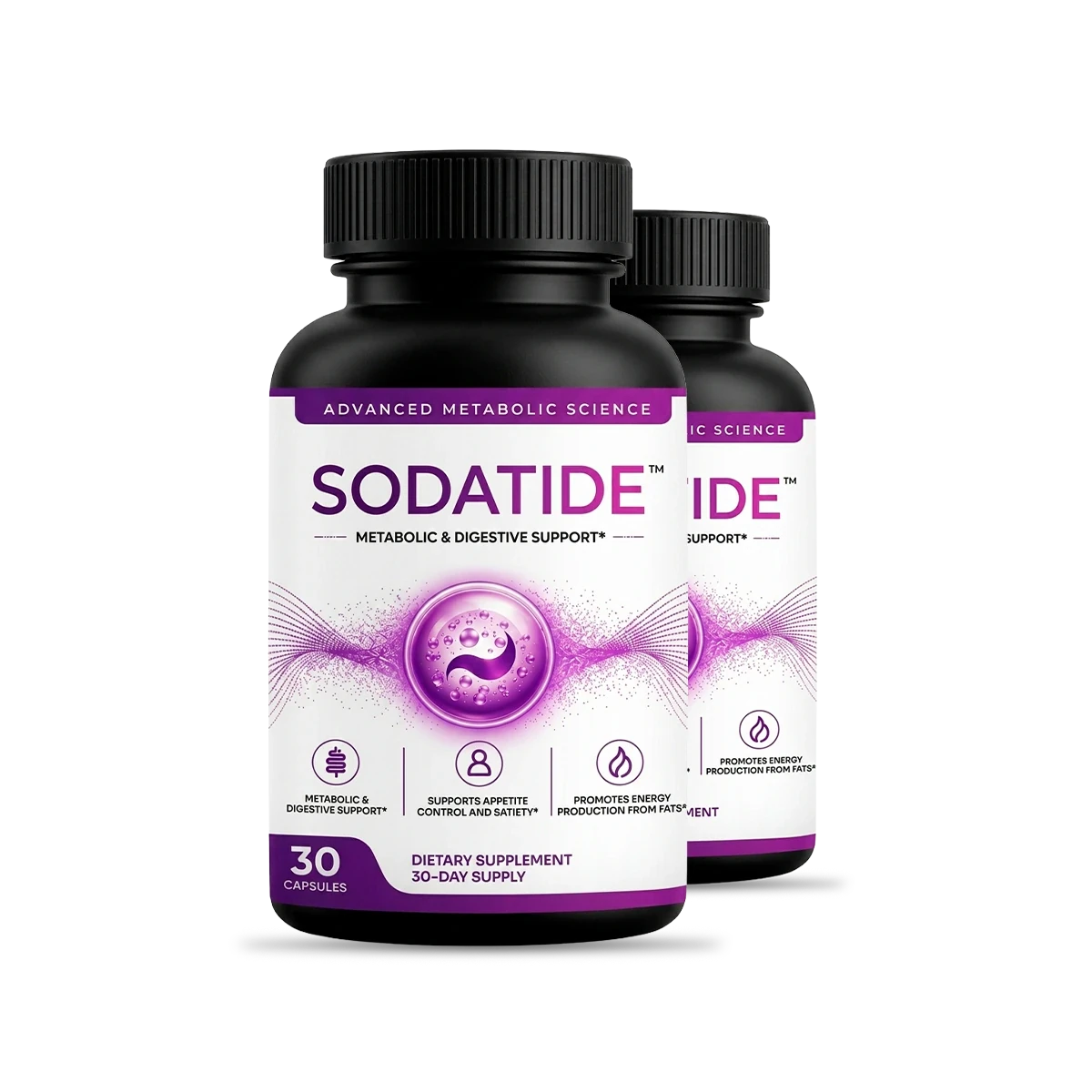
Lot SOD-26/SO-5430 · 30 capsules · one a day
What is SodaTide? The synbiotic capsule and its ingredients
SodaTide is a once-daily dietary supplement capsule for metabolic and digestive support. It is a synbiotic: chicory root inulin and potato resistant starch feed gut bacteria, and a probiotic blend adds live cultures. Each bottle holds 30 capsules.
Three ingredients on the front of the label, and what each one is.

The vendor ships one graphic that opens the product up, and it lists three things: chicory root inulin, potato resistant starch and a probiotic blend. The strip along its foot repeats the same count the bottle carries, thirty capsules, three named ingredients, dietary supplement.
Two of the three are fibres your own body cannot digest. They travel intact to the large intestine and are eaten there by resident bacteria, a process the literature calls fermentation. The third is the bacteria themselves. That pairing has a name in the field: a synbiotic, a live culture supplied alongside something for it to live on.
Chicory root inulin is the best documented of the three. It is the fibre most of the published prebiotic work is built on, and it has a straightforward story: it is a chain of fructose units, it survives the stomach, and the bacteria that thrive on it are measurable in a stool sample. A dose-response study in healthy volunteers walked it up from 2.5 to 10 grams a day and watched bifidobacteria counts rise at every step.
Potato resistant starch is starch that behaves like fibre. Cooked and cooled potato starch resists digestive enzymes, reaches the colon as substrate and is fermented there. The standard review of colonic fermentation sets out what comes back out of that process: short-chain fatty acids, principally acetate, propionate and butyrate, which are absorbed and used.
The probiotic blend is where the bottle says least. It is named as a blend and the artwork stops there, so the reader has a category rather than an organism. The ISAPP consensus statement is blunt about why that matters: a probiotic is defined as a live micro-organism that confers a benefit when given in an adequate amount, and both halves of that, the organism and the amount, are strain-specific.
How does SodaTide work? Five steps from capsule to appetite signals
SodaTide is meant to work in five steps. The capsule reaches the colon, resident bacteria ferment the fibre, short-chain fatty acids form, appetite signals may shift at some doses, and the live cultures add a separate effect.
Five steps, each of which has been measured in people.
The capsule reaches the colon largely intact
Inulin and resistant starch are both defined by what does not happen to them in the small intestine. Human digestive enzymes have no way through the bonds, so both arrive in the large bowel as food for something else. That is the entire mechanism at the first step, and it is not controversial.
Resident bacteria ferment it
Bifidobacteria and lactobacilli grow on inulin; a broader set works on resistant starch. The dose-response work is unusually clean here: fructo-oligosaccharide feeding raised faecal bifidobacteria in proportion to how much was eaten.
Fermentation produces short-chain fatty acids
Acetate, propionate and butyrate come out of that fermentation. They are absorbed through the colonic wall and used, and propionate in particular has been tested on its own: a 24-week trial delivered 10 grams a day of an inulin-propionate ester and measured appetite hormones, weight and liver fat.
Appetite signals shift, in some people, at some doses
This is the step the bottle's second line points at. The 12-week oligofructose study gave 21 grams a day and recorded lower ghrelin and higher peptide YY alongside a small weight change. A crossover in healthy adults at 16 grams a day measured about 5 per cent lower daily energy intake.
The live cultures add a second, separate mechanism
Probiotic effects are not fermentation effects. They are attributed to competition for space, to the products the organisms themselves make and to the gut barrier: a trial in adults with obesity measured barrier function directly and found Bifidobacterium strains improved it.
Every amount in the paragraphs above is measured in grams a day. The bottle asks for one capsule a day and the artwork carries no weight against any of the three names, so the comparison a buyer needs is set out in full in the honest label analysis further down this page and on the ingredients page.
Who SodaTide is for, and who should skip it
SodaTide is for adults aged 18 and over who eat a fairly low-fibre diet and want one small morning habit. Give it four to eight weeks. It is a poor fit for under 18s and for people with a suppressed immune system.
A daily habit for ordinary days, on the vendor's own framing.

The vendor's own scene puts the bottle in a kitchen and lists four settings: a morning routine, busy weekdays, family meals and evenings at home. That is an honest picture of what this product is, which is a habit rather than an intervention.
The people it suits are adults over eighteen who want one small thing to do each morning and who are willing to give it four to eight weeks before forming a view. A fermentable fibre works with a diet, not instead of one.
A good fit for SodaTide
- Adults 18 and over who eat a fairly low-fibre diet and want a nudge in the other direction.
- People who already take something in the morning and can attach a second capsule to the same cue.
- Anyone who has a refrigerator shelf they will actually use, because the bottle asks for one after opening.
- Buyers who are comfortable judging a product over a month or two rather than a week.
A poor fit for SodaTide
- Anyone under 18. The label is written for adults and this desk holds to it.
- People with an established bowel condition. Fermentable fibres are a known symptom trigger in irritable bowel syndrome, which is why low-FODMAP trials take them out deliberately.
- Anyone whose immune system is suppressed, who should discuss a live-culture product with their own clinician first.
- Anyone who wants a number on the label before they buy. This artwork gives three names and no weights.
The SodaTide routine, and the line on the bottle most people skip
The seller's routine is one capsule a day with an 8 oz. glass of water, taken in the morning and preferably before a meal. The bottle adds one more line that is easy to skip and worth reading twice: refrigerate after opening, to preserve the potency of the probiotics.
- One capsule. Thirty in a bottle, so a bottle is a month.
- With a full glass of water, which matters more for a fibre than for most capsules.
- Morning, before food, as the seller recommends.
- Into the refrigerator once the seal is broken, and back after each dose.
That last instruction is the one worth acting on from day one. Storage-stability work on live cultures is unambiguous that temperature is the variable that decides how many organisms survive to the end of a shelf life. A bottle that spends a summer in a warm bag is worth less than one that did not, and nothing on the outside of it will tell you which you have.
Wind and a full feeling in the first fortnight are the usual adjustment, and they are the expected consequence of feeding gut bacteria rather than a sign something is wrong. A tolerance crossover measured exactly this at 5 and 7.5 grams a day: bloating and flatulence rose slightly and stayed low on a twelve-point scale. The full routine, including what to do if a morning is missed, is on how to take SodaTide.
SodaTide safety checklist: eight things to settle before your first order
Before ordering SodaTide, settle eight points. Four are medical: blood-sugar medicine, immune system, bowel symptoms, and pregnancy, nursing, under 18 or IBS diets. Four are practical: the routine, the fridge, the first fortnight and keeping the order email.
The first four are medical and belong with your own clinician. The last four are practical and take a minute.
- Blood-sugar medicine. On insulin or tablets that lower blood sugar? Tell the prescriber before a product sold for appetite and satiety (NIDDK).
- Immune system. Live cultures are not for everyone: people who are seriously ill or immunocompromised face a higher infection risk, so ask a doctor first (NIH ODS).
- Bowel symptoms. Blood in the stool, black stools, or a change in bowel habits that has lasted weeks needs a clinician before any supplement (MedlinePlus).
- Pregnancy, nursing, under 18, IBS diets. The label asks the first three groups to consult a physician; chicory inulin is also a FODMAP for anyone on a low-FODMAP plan (NIDDK).
- The routine. One capsule each morning with an 8-ounce glass of water, before food. One is the whole dose.
- The fridge. After the seal is broken the bottle lives in the refrigerator, which matters for a six-bottle order.
- The first fortnight. Fibre that ferments makes gas; going gently is the usual advice (MedlinePlus on gas).
- The paperwork. Keep the order email: its order ID opens a claim inside the 60-day window, which runs from the date of purchase.
SodaTide Price on the Official Website
SodaTide costs $79 a bottle on two bottles ($158), $69 on three ($207) and $49 on six ($294) on the official website. Shipping is free in the US on three and six bottles. Every pack has a 60-day money-back window.
Three rungs, $49 to $79 a bottle, with a 60-day window on all of them.
$79
a bottle$158 total $179
- 2 bottles · 60 capsules
- 60-day supply at one a day
- Shipping charged at checkout
- 60-day money-back guarantee
Lot SOD-26/SO-5430 · ships from the U.S.
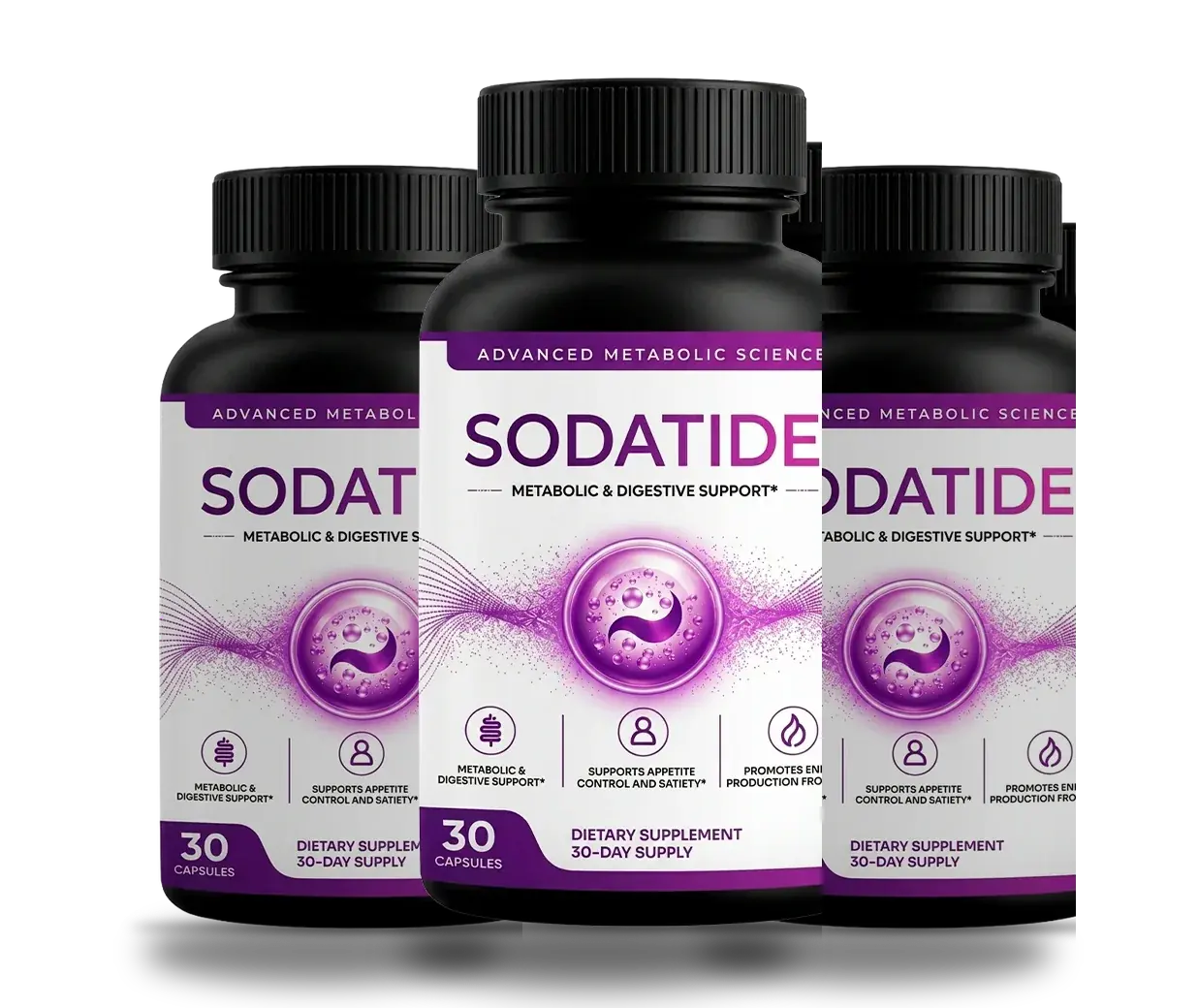
$69
a bottle$207 total $537
- 3 bottles · 90 capsules
- 90-day supply at one a day
- Free US shipping
- Six digital bonuses included
Lot SOD-26/SO-5430 · ships from the U.S.
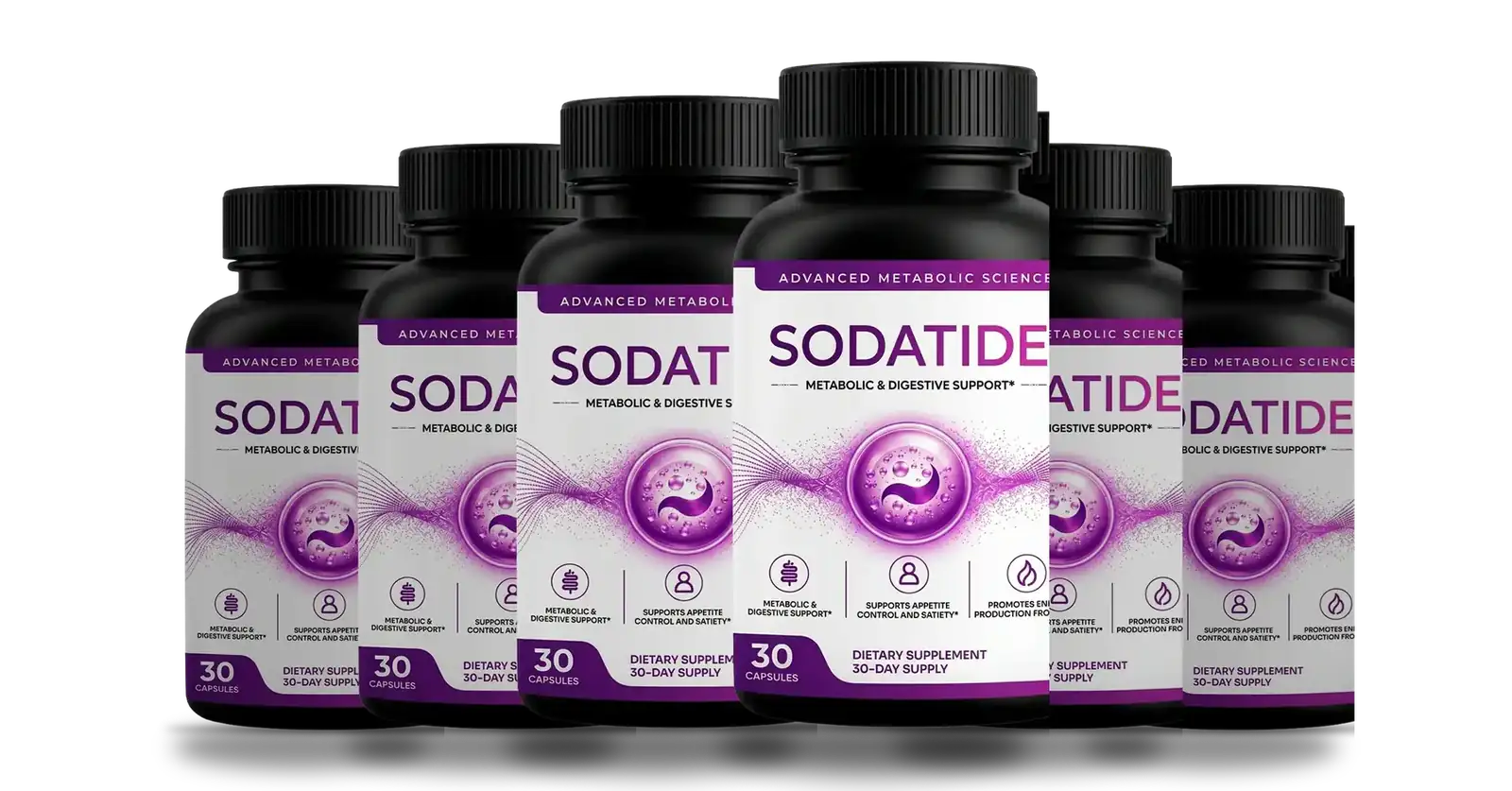
$49
a bottle$294 total $1074
- 6 bottles · 180 capsules
- 180-day supply at one a day
- Free US shipping
- Six digital bonuses included
Lot SOD-26/SO-5430 · ships from the U.S.
Prices as the seller prints them. The checkout shows the current figure, and the struck numbers are the seller’s own comparison prices rather than a recent selling price. Every rung is a single payment with no subscription behind it.
Postage is free on the three- and six-bottle rungs and charged at checkout on the two-bottle one. The three- and six-bottle rungs also carry the six digital bonuses. Every rung is a single payment: there is no subscription behind any of them and nothing rebills.
The six bonuses that come with the larger SodaTide packs
The three-bottle and six-bottle SodaTide packs include six digital bonuses, with stated values that total $358. Only two are on subject: the Renova Flora Protocol and the Personalized Usage Guide. The rest are general or unrelated downloads.
| Bonus | Stated value | What it actually is |
|---|---|---|
| Sleep Live Better | $67 | A routine-building guide on sleep, on the argument that a short night makes appetite harder to read the next day. |
| Accelerated Metabolism | $59 | An e-book on everyday eating patterns. Read it as general nutrition reading rather than as anything specific to this capsule. |
| Facial Rejuvenation | $67 | A skincare course. It has no connection to a gut capsule and this desk will not pretend otherwise; it is thrown in because bundles are built that way. |
| Renova Flora Protocol | $77 | A practical course on food-first changes to gut habits. The closest of the six to the subject on the bottle. |
| 10-Day Metabolic Challenge | $49 | Short daily tasks over ten days. The value of this kind of thing is that it gets somebody to write down what they actually do. |
| Personalized Usage Guide | $39 | A manual on when to take the capsule and what to pair it with. Useful mainly as a reminder mechanism. |
Stated values are the seller's own figures and total $358. They are digital downloads, so nobody was ever charged them.
Two of the six are on subject and four are bundle filler. The Renova Flora Protocol and the Personalized Usage Guide are about gut habits and about taking the capsule; the sleep, metabolism, skincare and ten-day-challenge titles are general wellness material that would be thrown in with anything. They are set out honestly on the bonuses page, with what each one is worth reading for.
SodaTide Reviews: what buyers report
SodaTide's seller reports a 4.4 out of 5 average across 871 written reviews and 6,613 orders, with 90% saying they would recommend it. These are the distributor's own summary figures, not verified transcripts.
Across 871 written reviews the seller reports an average of 4.4 out of five, with 90% saying they would recommend it and 6,613 orders behind those figures. Two thirds sit at five stars and five per cent at one or two.
The praise and the complaint are the same observation from two directions. What buyers like is the single daily capsule and the sixty-day window; what they complain about is a slow start, and wanting more in the first week. The most common wait reported here is 4–8 weeks, which lines up with the seller's own guarantee wording asking for at least thirty days of use before a refund conversation.
These are the distributor's summary figures rather than verified transcripts, and this desk treats them as a description of the customer base rather than as evidence about the formula. The roster, the themes and what the numbers can and cannot show are on the SodaTide reviews page.
Where SodaTide sits on the metabolism shelf
SodaTide is a synbiotic capsule, which pairs a fibre with a live culture. It sits between fibre powders, probiotic capsules and appetite-suppressant fibres, and it is not a stimulant fat burner. Nothing on the label is a stimulant.
| Approach | What it is | Where SodaTide sits |
|---|---|---|
| Prebiotic fibre powders | Inulin or resistant starch sold by the scoop, typically 5–10 g a serving | Same ingredients, a very different serving size. A scoop is dosed in grams; this is one capsule. |
| Multi-strain probiotic capsules | A named strain list with a colony-forming-unit count printed | SodaTide names a blend rather than strains, so it cannot be compared count for count. |
| Thermogenic “fat burner” capsules | Caffeine, green tea catechins, capsicum; stimulant-led | Nothing stimulant on this label. The three names here are all gut substrate or culture. |
| Appetite-suppressant fibres | Glucomannan or psyllium, taken with water before meals | Closest in intent. Those are bulking fibres; inulin and resistant starch work by fermentation instead. |
| Synbiotic capsules | A fibre and a culture in one capsule, exactly this combination | This is the category SodaTide is in, and it is a small and fairly new one. |
Categories as a shopper meets them on a shelf, not as a regulator defines them.
The useful comparison is the first row. The three ingredients on this bottle are the same three a fibre powder sells, and the entire published literature for them is written in grams a day. That is the distance a reader has to judge, and it is set out in the next section rather than spread across the page.
SodaTide ingredients label: what the artwork shows a reader
The SodaTide label artwork is a front label with a wordmark, a strapline, the capsule count and the supply length. It names three ingredients but prints no weights, no strain list and no Supplement Facts panel.
One section for everything the artwork leaves to the reader, so the rest of this page can describe the bottle.
The artwork supplied with this product is a front label. It carries the wordmark, the strapline, three icon captions, the capsule count and the supply length, and the vendor's ingredient graphic adds the three names. There is no Supplement Facts panel in the pack, which means no serving-size row, no milligram against chicory inulin, potato resistant starch or the blend, no colony-forming-unit count and no other-ingredients line.
This desk will not print a figure the bottle has not got. What it can do is print the figure each trial used, beside the name, so the distance is visible rather than implied.
Read that table the way a pharmacist would. A capsule is a container of a few hundred milligrams; the fibre work above is measured in grams a day, and the lowest useful inulin dose anywhere in that literature is the 8 grams used in the 16-week trial in children. The low-dose resistant potato starch analysis says the same thing about the second ingredient in its own words: the prebiotic and metabolic effects of resistant starches are linked to intakes above 15 grams a day.
The probiotic side has a different gap and it is the sharper one. Probiotic research is written strain by strain. The Akkermansia proof-of-concept study tested 10^10 cells a day of one organism for three months; the L. gasseri SBT2055 trial tested 200 grams a day of a fermented milk carrying one strain. Neither result transfers to a blend whose members are unnamed, and this site never transfers one.
None of that makes the capsule useless and none of it makes the ingredients wrong. Chicory root inulin, potato resistant starch and live cultures are three of the better-supported things in this whole category. What it does mean is that a buyer here is buying a habit and a small daily contribution rather than a trial dose, and should hold expectations at that level.
Three lines would close most of this: a weight against each fibre, a strain list with a colony count for the blend, and an other-ingredients line naming the capsule shell. Any of the three would let a reader do their own arithmetic, and the third matters to anybody avoiding gelatin.
SodaTide Reviews and Complaints, answered
Common SodaTide complaints are no change after ten days, wind, not knowing how much is inside, price changes, the fridge and the seals. Most are expected for a fermentable fibre or fair about the label, and each is answered below.
Six things buyers say, and what each one is worth.
“I took it for ten days and noticed nothing at all.”
That is the expected shape. Fermentation changes a bacterial population, and population changes take weeks. The shortest inulin trial that measured a bifidobacteria shift ran seven days and measured stool, not how anyone felt; the appetite and weight work ran six, twelve and sixteen weeks. Four to eight weeks is the honest window and it is what buyers here report.
“It gave me wind.”
Also expected, and it usually settles. Feeding gut bacteria produces gas, which is the mechanism working rather than failing. A four-week trial in people specifically selected for poor tolerance of intestinal gas found inulin at 8 grams a day actually reduced gas retention. If it does not settle by the third week, stop and read the side effects page.
“I cannot tell how much I am getting.”
Fair, and this desk agrees. The artwork names three ingredients and gives no weight for any of them, which is why the section above prints the trial amounts instead of estimating the capsule. Anyone who wants a countable dose should buy a fibre by the scoop and read the scoop.
“The price jumps around.”
The seller's own two-bottle rung prints a struck $179 beside a $158 total and a savings line that matches neither. The figure the checkout asks for is the total. Struck numbers on this ladder are comparison prices rather than a recent selling price, and the pricing page says so plainly.
“Refrigerating it is a nuisance.”
It is, and it is also the single instruction on this bottle most likely to affect what you actually swallow. Six bottles is six months of refrigerator space, which is a real argument for the three-bottle rung over the six-bottle one if space is tight.
“The seals look impressive and say very little.”
Largely true. Manufactured in USA is about where the bottle was filled. FDA-registered is a listing every plant holds. The GMP mark names no auditor and the doctor-formulated mark names no clinician. Testing and quality takes all eight of them apart one at a time.
SodaTide pros and cons
SodaTide's strengths are three well-studied ingredients, a once-daily capsule, a 60-day window and no stimulant. Its weaknesses are no printed weights or strains, the need for fridge space, and some wind in the first two weeks.
In its favour
- Three ingredients with a large, recent and genuinely readable literature behind them.
- A once-daily capsule, which is the routine people actually keep.
- A sixty-day window that is longer than the four to eight weeks most buyers here describe waiting.
- Free postage and six digital bonuses from the three-bottle rung upwards.
- No stimulant anywhere on the label, so it does not compete with coffee or with sleep.
Against it
- The artwork gives three names and no weights, so nothing can be checked against a trial dose.
- The blend names no organism and no colony count, which is the unit probiotic evidence is written in.
- It needs refrigerator space for as long as the pack lasts.
- Wind and fullness in the first fortnight are common enough to expect.
- The seller's price block does not reconcile on the two-bottle rung.
Is SodaTide legit? Our SodaTide review score
We score SodaTide on what a buyer can verify: ingredient choice 8 out of 10, routine 9, purchase terms 8, value 6, storage 5 and label disclosure 3. Disclosure scores lowest because no weights or strains are printed.
| What we scored | Out of 10 | Why |
|---|---|---|
| Ingredient choice | 8 | Chicory inulin, potato resistant starch and live cultures are three of the better-evidenced things in this category. |
| Label disclosure | 3 | Three names, no weights, no strain list and no other-ingredients line. |
| Routine | 9 | One capsule with water in the morning is about as easy as a supplement routine gets. |
| Storage | 5 | Refrigeration after opening is sensible for cultures and inconvenient for a six-month pack. |
| Purchase terms | 8 | Sixty days, free postage from three bottles, one payment, no rebill. |
| Value for money | 6 | $49 a bottle at the bottom rung is fair for a synbiotic capsule and hard to compare without a dose. |
Scored against what a buyer can verify, not against what the product is promised to do.
The short version: a sensible ingredient list in a container that does not tell you how much of it you are getting. If the label ever prints a panel, the disclosure score moves and so does the overall picture.
SodaTide at a glance: form, count, price and guarantee
SodaTide is a once-daily capsule sold as metabolic and digestive support. It has 30 capsules a bottle, three named ingredients and no printed amounts. It costs $79, $69 or $49 a bottle and has a 60-day guarantee.
One table for anyone summarising this page. Every row comes from the SodaTide label, the seller’s own information page or this desk’s written policy.
| Product | SodaTide, a once-daily capsule sold as metabolic and digestive support |
| Form | Capsule. Not a gummy and not liquid drops |
| Count | 30 capsules a bottle, a 30-day supply |
| Routine | One capsule daily with an 8 oz. glass of water, morning, before a meal |
| Storage | Refrigerate after opening |
| Named ingredients | Chicory root inulin, potato resistant starch, probiotic blend |
| Amounts on the artwork | None. The pack carries a front label and no Supplement Facts panel |
| Label claims | Metabolic and digestive support; supports appetite control and satiety; promotes energy production from fats |
| Prices | $79 a bottle on two, $69 on three, $49 on six |
| Shipping | Free in the US on three and six bottles |
| Guarantee | 60 days from purchase, opened bottles included |
| Seller | Sodatides, the Official U.S. SodaTide Shop, New York |
| Order support | The order desk, listed in the site footer |
How SodaTide is made, and what the seals on the pack mean
The SodaTide pack carries eight marks, including Manufactured in USA, FDA-registered facility, GMP and Non-GMO. They describe the plant and the sourcing. FDA-registered is a facility listing, not an FDA review or approval of the formula.
 Manufactured in USAA statement about where the bottle was filled. It is not a claim about where the chicory, the potato starch or the cultures were grown.
 FDA-registered facilityRegistration is a listing every U.S. supplement plant must hold. It is not an FDA review of this formula and not an approval.
 GMPGood Manufacturing Practice describes how a plant documents its work. The mark on this pack names no auditing body and carries no certificate number.
 Non-GMOA sourcing statement. Chicory root and potato starch are both ordinary food crops, so this is a low bar rather than a distinguishing one.
 Natural ingredients“Natural” has no fixed regulatory meaning on a supplement label. Inulin and resistant starch are food-derived, which is the checkable part of it.
 VegetarianThe artwork prints no other-ingredients line, so the capsule shell is not identified. Anyone avoiding gelatin should read the bottle in their hand before the first capsule.
 Naturally gluten free“Naturally” is the operative word: it points at the ingredients rather than at a tested threshold or a certification mark.
 Doctor formulatedThe mark names no clinician and no credential anywhere in the pack, so there is nobody to look up. Treat it as decoration.
Eight marks ship with this pack and each one is a statement about something specific. Read together they describe an ordinary contract manufacturing arrangement in the United States, which is what almost every bottle in this category describes. Testing and quality goes through them one at a time, including the two that name nobody.
SodaTide side effects, storage and who should wait
SodaTide is for healthy adults aged 18 and over. Wind and a full feeling are common in the first two weeks. Wait and ask a clinician if you have irritable bowel syndrome or a suppressed immune system. Refrigerate after opening.
The artwork is the source for everything on this website, and the bottle in your hand is the source for you. Where the two differ, the bottle wins. Anything that looks wrong on a delivered pack should go to the order desk with the lot from the base.
- For healthy adults aged 18 and over, and not for anyone under 18.
- Wind, rumbling and a full feeling are the common first-fortnight effects of a fermentable fibre and usually settle by the third week.
- Anyone with irritable bowel syndrome should know that fructans are one of the food groups low-FODMAP trials remove on purpose, so this is a plausible symptom trigger rather than a neutral addition.
- Live-culture products have been associated with bloodstream infection in people whose immune systems are suppressed. It is rare and it is documented, and it is a conversation to have with your own clinician before starting.
- Refrigerate after opening, as the bottle asks, and keep it out of a warm bag.
- Keep to one capsule a day unless a clinician tells you otherwise.
None of that is a warning about this particular formula. It is what is known about fermentable fibre and live cultures generally, which is the honest basis for a label that names ingredients without weights. The detail, including what to do about a reaction, is on side effects.
SodaTide FAQ: form, price, directions and refund
These are the questions asked most about SodaTide: what it is, how to take it, the capsule form, the ingredients, how long it takes, where to buy it, the price, the refund and safety. Each answer comes from the label and the seller terms.
What is SodaTide?
SodaTide is a once-a-day dietary supplement capsule for metabolic and digestive support, 30 to a bottle. The front of the bottle names three ingredients: chicory root inulin, potato resistant starch and a probiotic blend. That is all the artwork declares.
What are the ingredients in SodaTide?
SodaTide names chicory root inulin, potato resistant starch and a probiotic blend. The label prints no weight for any of them and names no probiotic strain or colony count, and there is no Supplement Facts panel in the artwork. Read the bottle you receive.
What is the best time to take SodaTide capsules?
The best time to take SodaTide is the morning, before a meal, as the seller recommends. Take one capsule with an 8 oz glass of water. Keep the bottle in the fridge after opening to protect the probiotics. One capsule is the whole daily dose.
Does SodaTide work, and how long does it take?
Results differ from person to person. Buyers on this site most often describe four to eight weeks before they can judge it, and the seller's guarantee assumes at least thirty days of use. A fermentable fibre works on gut bacteria slowly, so a week tells you little.
Does SodaTide work for weight loss?
The bottle sells SodaTide as metabolic and digestive support, with appetite control and satiety among its label claims. It is not sold as a weight-loss product. It suits adults who want help with digestion and appetite between meals, and buyers most often wait four to eight weeks.
What are the side effects of SodaTide?
Some wind, rumbling and bloating is common in the first two weeks while gut bacteria ferment new fibre, and it usually settles. Stop and see a clinician for pain, blood in the stool or symptoms that keep worsening.
Who should not take SodaTide?
SodaTide is not for anyone under 18. Ask a doctor first if you take insulin or other glucose-lowering medication, are pregnant or nursing, have a weakened immune system or follow a low-FODMAP plan for irritable bowel syndrome. Live cultures carry a higher infection risk in people who are seriously ill.
Is SodaTide FDA approved?
No. SodaTide is a dietary supplement, and supplements are not FDA approved. The FDA-registered facility mark on the pack is a listing every U.S. supplement plant holds. It is not an FDA review of this formula and not an approval.
How much does SodaTide cost?
SodaTide costs $79 a bottle for two bottles, $69 a bottle for three and $49 a bottle for six. Postage is free on the three and six-bottle packs and charged at checkout on the two-bottle pack. There is no single-bottle option, and the checkout shows the current figure.
Where can I buy Soda Tide, and is this the official website?
Buy Soda Tide through sodatides.com, the official U.S. SodaTide shop. Orders placed here are covered by the 60-day money-back guarantee this site administers, and a bottle from a marketplace listing is outside it. The site is a retailer, not the manufacturer.
Is SodaTide legit? What do SodaTide reviews say?
Yes. SodaTide is a real capsule sold through sodatides.com, the official U.S. SodaTide shop, and the bottle names its three ingredients. The seller reports a 4.4 out of 5 average across 871 written reviews. Every order has a 60-day money-back guarantee from the date of purchase.
What is the SodaTide refund policy?
SodaTide has a 60-day money-back guarantee from the date of purchase, opened bottles included. Call the order desk with your order ID, then post the bottles to the returns address with your full name, email and order ID in the parcel. Return postage is your cost.
Is SodaTide a gummy or liquid drops?
No. SodaTide is a capsule, 30 to a bottle, taken once a day with an 8 oz glass of water. This page states it is not a gummy and not liquid drops.
How long does one bottle of SodaTide last?
A bottle holds 30 capsules and the dose is one capsule a day, so one bottle is a 30-day supply.
Do people spell it SodaTide or Soda Tide?
Both spellings mean the same product. The brand writes SodaTide as one word, and many shoppers type Soda Tide with a space. Either way it is the same once-a-day synbiotic capsule, 30 to a bottle, sold here at sodatides.com.
How does SodaTide work in the gut?
SodaTide works as a synbiotic. Chicory root inulin and potato resistant starch pass the stomach and are fermented by bacteria in the colon, which makes short-chain fatty acids. The probiotic blend adds live cultures beside that fibre, which is why the bottle is kept cold.
Is there caffeine or a stimulant in SodaTide?
No. Nothing on the SodaTide label is a stimulant and there is no caffeine, so it sits easily next to a morning coffee. The formula is two prebiotic fibres and a probiotic blend in one capsule a day.
Who reviews the SodaTide information on sodatides.com?
The Sodatides Editorial Team writes each SodaTide page, and Dr. Spencer Berry, MD reviews it for medical accuracy. The review checks the page, not your own health. Ask your doctor before you start any new supplement.
Further SodaTide reading from this desk
This desk offers six longer SodaTide reads, such as how long it takes to work, chicory root inulin gram by gram and resistant starch explained. They give the trial background to the three ingredients.
Six longer pieces for anyone who wants the background first.
- How long does SodaTide take to work?A week-by-week account of what fermentable fibre does first and what takes longer.
- Chicory root inulin, gram by gramThe 8, 16 and 21 gram doses in the trials, and what each one moved.
- Resistant starch, explainedWhy potato starch that resists digestion behaves like fibre once it reaches the colon.
- Probiotic blends and strain namesWhy probiotic research is written strain by strain, and what that means for a label.
- The metabolism supplement guideWhat the category holds, where the evidence sits, and where it runs out.
- Eight questions for any labelA checklist to use on SodaTide or any capsule beside it on the shelf.
How this SodaTide page was sourced, and by whom
Seventeen of the forty-three sources this website cites, chosen because this page leans on them directly. Each one was confirmed against the NCBI record during the build, and the amount the trial used is part of the line.
- Parnell JA, Reimer RA, 2009: “Weight loss during oligofructose supplementation is associated with decreased ghrelin and increased peptide YY in overweight and obese adults” in Am J Clin Nutr 89(6):1751-9, PubMed ID 19386741 (Dose 21 g a day for 12 weeks) — PubMed entry
- Cani PD, Joly E, Horsmans Y, Delzenne NM, 2006: “Oligofructose promotes satiety in healthy human: a pilot study” in Eur J Clin Nutr 60(5):567-72, PubMed ID 16340949 (Dose 8 g twice a day, 16 g a day in total) — PubMed entry
- Nicolucci AC, Hume MP, Martinez I, et al, 2017: “Prebiotics Reduce Body Fat and Alter Intestinal Microbiota in Children Who Are Overweight or With Obesity” in Gastroenterology 153(3):711-722, PubMed ID 28596023 (Dose 8 g a day of oligofructose-enriched inulin for 16 weeks) — PubMed entry
- Bouhnik Y, Raskine L, Simoneau G, Paineau D, Bornet F, 2006: “The capacity of short-chain fructo-oligosaccharides to stimulate faecal bifidobacteria: a dose-response relationship study in healthy humans” in Nutr J 5:8, PubMed ID 16569219 (Doses 2.5, 5.0, 7.5 and 10 g a day for 7 days) — PubMed entry
- Bouhnik Y, Vahedi K, Achour L, et al, 1999: “Short-chain fructo-oligosaccharide administration dose-dependently increases fecal bifidobacteria in healthy humans” in J Nutr 129(1):113-6, PubMed ID 9915885 — PubMed entry
- Bush JR, Han J, Deehan EC, et al, 2024: “Resistant Potato Starch Supplementation Reduces Serum Free Fatty Acid Levels and Influences Bile Acid Metabolism” in Metabolites 14(10):536, PubMed ID 39452917 (Dose 3.5 g a day; the paper notes that the prebiotic and metabolic effects of resistant starches are linked to intakes above 15 g a day) — PubMed entry
- Topping DL, Clifton PM, 2001: “Short-chain fatty acids and human colonic function: roles of resistant starch and nonstarch polysaccharides” in Physiol Rev 81(3):1031-64, PubMed ID 11427691 — PubMed entry
- Chambers ES, Viardot A, Psichas A, et al, 2015: “Effects of targeted delivery of propionate to the human colon on appetite regulation, body weight maintenance and adiposity in overweight adults” in Gut 64(11):1744-54, PubMed ID 25500202 (Dose 10 g a day of inulin-propionate ester for 24 weeks) — PubMed entry
- Depommier C, Everard A, Druart C, et al, 2019: “Supplementation with Akkermansia muciniphila in overweight and obese human volunteers: a proof-of-concept exploratory study” in Nat Med 25(7):1096-1103, PubMed ID 31263284 (Dose 10^10 live or pasteurised cells a day for three months) — PubMed entry
- Kadooka Y, Sato M, Imaizumi K, et al, 2010: “Regulation of abdominal adiposity by probiotics (Lactobacillus gasseri SBT2055) in adults with obese tendencies in a randomized controlled trial” in Eur J Clin Nutr 64(6):636-43, PubMed ID 20216555 (Dose 200 g a day of fermented milk carrying the strain, for 12 weeks) — PubMed entry
- Hill C, Guarner F, Reid G, et al, 2014: “Expert consensus document: The International Scientific Association for Probiotics and Prebiotics consensus statement on the scope and appropriate use of the term probiotic” in Nat Rev Gastroenterol Hepatol 11(8):506-14, PubMed ID 24912386 — PubMed entry
- Swanson KS, Gibson GR, Hutkins R, et al, 2020: “The International Scientific Association for Probiotics and Prebiotics (ISAPP) consensus statement on the definition and scope of synbiotics” in Nat Rev Gastroenterol Hepatol 17(11):687-701, PubMed ID 32826966 — PubMed entry
- Krumbeck JA, Rasmussen HE, Hutkins RW, et al, 2018: “Probiotic Bifidobacterium strains and galactooligosaccharides improve intestinal barrier function in obese adults but show no synergism when used together as synbiotics” in Microbiome 6(1):121, PubMed ID 29954454 — PubMed entry
- Chaluvadi S, Hotchkiss AT Jr, Call JE, et al, 2012: “Protection of probiotic bacteria in a synbiotic matrix following aerobic storage at 4 degrees C” in Benef Microbes 3(3):175-87, PubMed ID 22968408 — PubMed entry
- Azpiroz F, Molne L, Mendez S, et al, 2017: “Effect of Chicory-derived Inulin on Abdominal Sensations and Bowel Motor Function” in J Clin Gastroenterol 51(7):619-625, PubMed ID 27680592 (Dose 8 g a day for 4 weeks in people with poor tolerance of intestinal gas) — PubMed entry
- Holscher HD, Doligale JL, Bauer LL, et al, 2014: “Gastrointestinal tolerance and utilization of agave inulin by healthy adults” in Food Funct 5(6):1142-9, PubMed ID 24664349 (Doses 5.0 and 7.5 g a day over three 21-day periods) — PubMed entry
- Staudacher HM, Lomer MCE, Farquharson FM, et al, 2017: “A Diet Low in FODMAPs Reduces Symptoms in Patients With Irritable Bowel Syndrome and A Probiotic Restores Bifidobacterium Species: A Randomized Controlled Trial” in Gastroenterology 153(4):936-947, PubMed ID 28625832 — PubMed entry
Put SodaTide on the shelf and start tomorrow morning
One capsule a day, thirty to a bottle, with the sixty-day window administered by this desk rather than by a marketplace seller. The three- and six-bottle rungs ship free in the United States and carry the six digital bonuses.
Two bottles $158 · six bottles $294 · 60-day money-back guarantee
Order SodaTide On The Official WebsiteOne capsule a day · 30 per bottle · lot SOD-26/SO-5430
More about SodaTide
More SodaTide pages from this site cover the ingredients beside the amounts trials used, the pricing and the written reviews. Each page reads the same label artwork and seller terms in more detail.